

Every community has a commons — a park, a library, a garden — a shared space that only thrives when people care for it together. Our local information ecosystems are no different. They, too, depend on shared care.
It’s this belief that motivated the American Press Institute to bring together more than 70 local news and civic leaders for our Local Summit on Inclusion, Belonging and Local Leadership this fall. Together, we explored what it means to steward, not just sustain, local information.
As is all too familiar to our field, the urgency is now. Our capacity continues to constrict. Our community’s attention is further fractured and fragmented. Mistrust presses in from all sides. A bright spot in our sight, however, is that Americans continue to show a strong appreciation for local news — the majority use local news and information every day and 9 out of 10 agree it’s necessary for democracy to work properly, according to the Press Forward newsroom toolkit. And stats like that ought to inspire more opportunities to transform the transaction that local news can sometimes feel like into an authentic relationship with local community.
People want to connect. Research from More in Common has shown us this. But they need structures to do so. Collectively, we need structures and systems to shift us from journalism “for” the community to journalism “with” the community. So, we asked the room: What does it mean to be gardeners, guards and stewards of the local information commons?
The local information commons
Our API Local News Summits serve news leaders, who made up the majority of our room in D.C., but among them were civil society leaders, researchers and community members trying to make their communities better through information sharing. Every leader present was actively engaged in this commons as a shared civic resource. No one owns this commons, but everyone should contribute to it. Journalism isn’t the whole of the commons — it is one caretaker among many.
Journalism + Design’s “acts of journalism” framework furthers this idea.
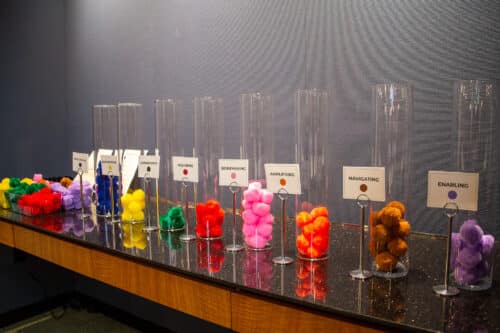
It’s important to understand all the ways journalism can serve communities beyond just reporting and interviewing — facilitating, documenting, commenting, inquiring, sensemaking, amplifying, navigating and enabling.
The latter are roles journalism can play — and acts of stewardship that our communities might already be doing with or without a personal connection to their local news source. Residents might document a public interaction with police on their phone. They might ask a question to government officials and share the answer in an online neighborhood forum. They might comment on what is happening at the local school board to their own followers or friends on Instagram.
At our summit, we asked news leaders to consider what it looks like to view their current work and the information-sharing of their community collectively. The image of journalists and residents alike as contributors to a shared information commons might better move news leaders from…
- Competition → collaboration
- Coverage → connection
- Othering → belonging
- Informing → empowering
It’s a tool for thinking about your strengths as a news organization, even with limited capacity, and the strengths and practice of people in your community.
Reader mini-reflection: Locating your place in the commons
What are you doing that you’re best at? What is your community better at than you? How might you build from your community’s existing strengths rather than duplicating them?
The hurdles of stewardship
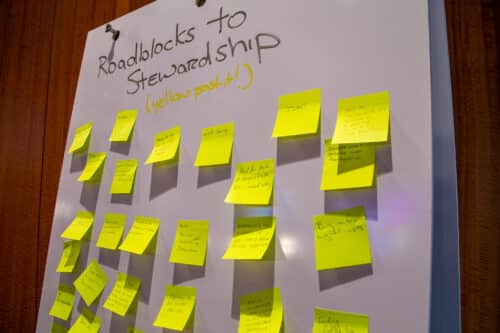
Even shared care has friction. Across the summit, news leaders named real roadblocks that slow collective stewardship, those attempts at deep collaboration between news organizations and community. And these roadblocks aren’t just in their communities; they’re personal and organizational, too.
- Capacity: Limited staff time, funding and bandwidth to build the relationships that stewardship needs.
- Control: Fear of losing editorial authority or brand clarity when others participate in our newsmaking.
- Trust gaps: Communities are wary from past harms, and newsrooms are unsure how to rebuild credibility.
- Power dynamics: Unspoken hierarchies or inflated senses of self can make collaboration between journalists and residents uneven.
- Measurement: The field continues to lack metrics for belonging, impact or care, making it easier to count clicks or subscribers than connection.
- Fear of vulnerability: There’s a cultural tension between journalistic objectivity and emotional openness. Can the community participate in our journalism while also being reported on?
These are real constraints. But they’re also signals of where new forms of leadership are most needed. Stewardship doesn’t begin when obstacles disappear but when we decide to share the work anyway.
Reader mini-reflection: What’s in the way?
What makes stewardship feel risky in your context? Which of these hurdles shows up most often for your newsroom, and how might you begin to name this roadblock out loud?
From control to collective stewardship
Stewardship begins when we stop asking, “How do we reach our audience?” and start asking, “How do we care for our community’s shared understanding?”
This is not a question to be solved on the dance floor — or the mosh pit, as our summiters joked. Like every moment of deliberate change, this is a balcony time question. Because news leaders can’t steward alone, nor should they.
Getting to the balcony is a leadership strategy. It is about making space to see clearly what’s in your way and making one deliberate move to change it. Once you’re out of the news cycle, you’re better able to spot bottlenecks to your work as well as natural flows and momentum that lead to innovative solutions.
From the balcony, you can delegate more effectively with care. That might be delegating within your own organization — or, as we proposed, how to “delegate” the jobs a much larger newspaper once did to community members who are already sharing information in a similar way. For example, if you can’t afford a food critic, but still see that local commentary and criticism as valuable, how might you partner with community members making their own humorous restaurant reviews on TikTok or YouTube?
Delegation turns journalism from a service for people into a practice with people. It’s not about offloading work, but redistributing power and feeding potential.
When journalists trust residents to conduct acts of journalism, the information commons grows to include community correspondents and ambassadors, youth reporting beats, bilingual storytelling and more.
Whether or not we delegate to and collaborate with our communities, information stewardship is already underway in both news and non-news spaces.
We saw three stewardship patterns at the summit:
- Cultivating new caretakers as journalists across the country bring their newsroom experience to both traditional and nontraditional learning spaces, teaching not just the next generation of reporters but also teaching our neighbors how to tell their own stories.
- Designing for belonging as information stewards focus on the invitation, inclusion and distinct membership of community voices at live events, civic centers and online forums, each creating experiential and joyful spaces for connection.
- Sharing power across systems as local creators and communicators partner to bridge divides, collect experiences and share information for the good of the whole, including dialogue, asset mapping and co-created governance.
These leaders showed us that tending the commons doesn’t begin in the newsroom. It begins wherever trust, creativity and civic life already intersect.
Reader mini-reflection: Recognizing and responding to trust
Think about a time when someone outside your newsroom showed they were ready for more trust. What did that signal look like and how did you respond? Now, imagine what it would mean to respond more fully. Where might sharing authority with residents create new capacity for them and for you? What’s one small act of journalism you could prepare to delegate to your community as a sign of shared stewardship?
Get in motion
For journalists, the work ahead isn’t to rebuild the information commons alone but to participate alongside others in how the commons is contributed to and cared for.
To do this, we should hold onto the positive psychology tactic of “strategic optimism,” not as a mood but as a leadership posture. As strategic optimists and information stewards, we can decide to:
- See a situation or problem as a challenge instead of a threat
- Identify pieces of the challenge that we can control and solve
- Walk toward the problem, actively engaged in affecting change
- Use humor to cope when things get tough
By using optimism as a tool, we can become engaged participants in the commons. To start, consider the following principles of collective stewardship that surfaced through API’s time with the news leaders actively modeling it.
First, see the system. Get out of the news cycle and out of the newsroom, and step onto the balcony. From this new vantage point, identify your ecosystem’s assets and bottlenecks. Reflection: What patterns can you see now that were invisible from the ground?
Second, share the power. Use your leadership with purpose by inviting co-creation, co-authorship and co-designers into your mission of supporting an informed and engaged public — just like when you delegate within your own newsroom. Remember, too, that sharing power goes both ways, so allow yourself to be coached up and delegated to by the community, too. Reflection: Who in your community is already doing part of your journalism? How might you collaborate with them instead of compete?
And third, tend the commons. Measure success by belonging, participation and shared cultural touchpoints, not just metrics. Expand your definition or acknowledgment of conversation. Prepare surveys, gather both structured data and qualitative stories of a healthy commons. Reflection: How are you nourishing the local information ecosystem, and not just sustaining your organization?
Reader mini-reflection: What will you tend?
What shift in yourself, your newsroom or your community are you most ready to begin tending? Who will you tend it with?
***
The local information commons is ours to tend — together. Each act of listening, documenting and connecting is a seed of trust. And each time we share authority with our community, we plant resilience and grow belonging, or membership.
Journalism’s renewal and reinvention won’t come from guarding our gate but from gardening the ground we share.
Gratitude goes to the John S. and James L. Knight Foundation for supporting our API Local News Summit on Inclusion, Belonging and Local Leadership. Their support expands public-facing resources like these we can make from this gathering. To learn more about supporting future API Local News Summits of news leaders, please contact us.
You might also be interested in:
We asked four summit participants to share more about the ways they are defining, measuring and acting on signals of impact.
Whether it’s an engaging personality breaking down complicated news on YouTube, a streamer testing their limits on an obstacle course or a short film series that meets people where they’re at, content consumption is fragmented — but also gives newsrooms an opportunity to create niche content that can succeed if paired with the right distribution strategy.
If you want to know how to reach teens and young adults, ask young journalists and the folks who work with them.


