
Youth engagement is happening in local newsrooms across the country and through that engagement, trust is being built. But neither engagement nor trust is visibly changing how most of these same newsrooms operate.
There are programs that teach young people both journalism skills and the acts of journalism in community information ecosystems. There are live events and advisory councils. There are both budding and sustained partnerships with school districts and universities, libraries and museums.
But these efforts to engage young people don’t automatically translate into embedding their voices and needs in the daily news operation. These efforts, instead, often remain peripheral: youth are visible in programs, engagement and talking points, but invisible in how decisions are made, how success is measured and how communities shape coverage.
The issue isn’t about effort. It’s about where young people are involved and influential. It’s about where their perspectives, habits and even expectations shape what happens next.
Many news leaders want to move from youth participation to youth integration, and they have strong beliefs and reasons for doing so. But they also have real constraints: Limited staff time, competing priorities, pressure to deliver on immediate metrics or impact.
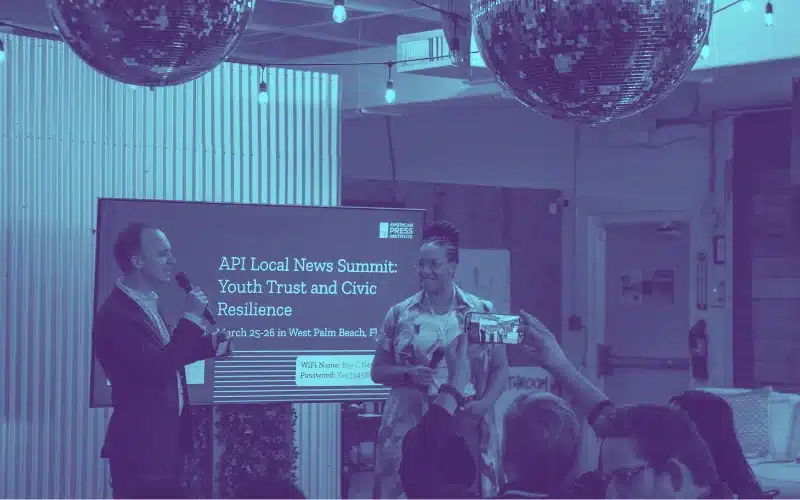
Which is why youth trust can only be more visible in our news organizations when we design with our constraints in mind. At a recent API Local News Summit, we worked with newsrooms to take smaller, more focused shifts to embed youth perspectives into everyday workflows, to test ideas in short learning cycles and to redefine what counts as success.
Across newsrooms experimenting with youth engagement and its role in their community’s civic resilience, several patterns have become clear enough to share. Taken together, you have a field guide grounded in real newsroom behavior and designed to make youth trust more visible — and durable — in your news organization.
1. Start with what’s already trying to happen
Most newsrooms don’t need more ideas or even more data. They have enough to keep them busy for a lifetime. What they do need, however, is attention to the signals already sounding.
- You’ve hosted a one-off youth event that didn’t repeat, but has positive survey data
- You have an existing but informal teacher relationship
- You hear from youth on Instagram but don’t bring their voices into editorial meetings
These are signals worth responding to. The goal here isn’t to build something new; it’s to listen and respond to what’s already trying to happen.
Try this: What’s one place where youth input already shows up but doesn’t change what happens next? Name it and then track this input over the next week.
2. Put your influence where decisions actually happen
Research in organizational psychology has shown that influence and engagement are not the same. You can be engaged but never have proximity to, or influence over, decisions.
You may be working at a youth-centered organization or on a youth-centered project in a larger news organization. If youth input isn’t shaping decisions, it’s merely observation, not true and embedded influence.
What does this embedded influence look like?
- Youth co-selecting monthly story themes
- A youth voice included in planning meetings
- A reporter sourcing from youth communities consistently
Try this: What is one decision in your newsroom that could include youth input this month… without adding a new meeting? Name it, then influence it.
3. Turn feedback into something that changes outcomes
Most news organizations already gather input, whether in audience surveys, via newsletters and Qualtrix pop-ups or in all-hands and editorial meetings. But what about converting that feedback into decisions?
This is the gap between listening and acting, a gap that can be closed one baby step at a time.
- Baby step 1: Know why we’re non-responsive to feedback: because it feels too vague, too risky or too challenging to our identity (or status quo).
- Baby step 2: Optimize for relational, not extractive, listening by checking for understanding and intentionally closing the loop.
- Baby step 3: Share what has changed because of the feedback.
Listening will build trust, but acting on what you heard builds credibility. And this is not just with the surveys we promote but never fully mine or the archive we lose on our desktops without the community ever seeing. It’s also with the community canvassing and listening sessions that have no follow-up. It’s with the youth ideas and input that never reach decision-makers.
Feedback without visible change — operational, editorial, behavioral — will erode trust faster than no feedback at all.
Try this: What feedback have you already collected that hasn’t changed anything yet? How might you use it in the next 2 weeks?
4. Measure what matters to young people (hint: not just traffic)
What you measure will quietly determine what your newsroom becomes.
If you’re of the mind that Gen Z and Gen A aren’t future news consumers, but ever-present ones, then measuring traffic, social engagement or digital subscriptions is missing the point.
API’s Metrics for News can help you identify patterns across all your data sources and helps news leaders find places to better align everyday coverage to longer-term audience engagement goals. Want to learn more? Sign up for a free demo.
When the goal is to make youth trust more visible in our news operations, the way we define success must evolve because what we measure will inevitably determine what we repeat. So consider also tracking:
- Repeat participation
- Depth of engagement, including tagging and bringing a friend
- Depth and sentiment of conversation
- Youth-defined success
- Belonging and connection
Try this: What’s one sign of trust from a young person that you currently don’t track, but could start noticing?
5. Start smaller than feels impressive
Beyond youth strategies, any new strategy often risks failure when it’s too big to sustain. So, when it comes to reporting for, co-creating with and defining success alongside Gen Z and Gen A news consumers, we have to actively resist the urge to go too big, build for too many or execute across too long a timeline.
Instead, we should make our work small enough to run — and safe enough to try. Both will allow us to learn as we experiment and to maintain momentum during and after.
In practice, this looks like exploring youth trust and engagement with local news through:
- One school, not a full school district
- One format, not an entire product and mutli-platform approach
- One meeting, not a new workflow
Thinking small is a muscle we have to work out in order to grow. Taking baby steps is a practice we must all re-learn and refresh regularly. Because we ought not to be designing anything that can’t survive the daily realities and constraints of our news organizations and the news cycles we respond to.
Try this: What’s a version of your idea that could run in 4 weeks or 90 days — not 6 months and definitely not a year?
6. Design within your constraints — not around them
It is unlikely that all the constraints we feel in the local news field will just go away overnight or dissolve with more funding and more staff. Because even if they did, we’re just bad at taking on more. As journalists, we have a calling to report and to serve our community, and that means we are always working against the same constraint: capacity.
But what if we changed our perspective on what we lack? What if capacity isn’t a blocker as much as it is a design condition? Instead of experimenting around staff limits, workflow dysfunctions and competing priorities, let’s design within those constraints.
- Name what would strain first
- Envision what can survive your current reality
- Set an hour-limit on experimentation (2-3 hours a week, maybe)
- Embed your experiment into an existing workflow
- Resist adding new meetings
Try this: If you could only spend 2 hours a week on this, what would you actually do?
7. Borrow skills from outside journalism
When it comes to engaging youth as present news consumers and contributors, it’s clear that newsrooms cannot rely on reporting alone. While “meeting them where they are” has become a common goal in newsrooms across the country, there is now added tension: where they are — or want to be — doesn’t always include online spaces.
So what does this mean for enabling youth trust within the local information commons?
It means recognizing that young people are increasingly disengaged from traditional news habits while also feeling less engaged in their communities — and everyone is unsure how to connect.
It means we can’t build trust exclusively through content. We must earn it and act on it through lived and thoughtfully designed experiences.
To do this well, we have to expand our capabilities as journalists, whose core trust-building skills aren’t often taught in j-schools, newsrooms or even at conferences. These skills include:
- Facilitation, as one would in advisory councils
- Co-creation methods, as one would to develop, design and publish reported zines
- Community organizing, as one would for voter guides or asset maps
Try this: What’s one skill your newsroom doesn’t currently have that this work clearly requires? How might you get it, borrow it or delegate it to make your youth engagement work really stick?
The newsrooms making progress are respecting the process. It can be easy to forget to start small. The pressures of securing funding and proving impact are heavy. But as we have learned, and often need reminding of, baby steps don’t just get you there. They also equip you with the knowledge and capabilities necessary to make your youth engagement efforts influential, visible and repeatable.
Gratitude goes to the Kiplinger Program in Public Affairs Journalism as one of several supporters of our API Local News Summit on Youth Trust and Civic Resilience. Their support expands public-facing resources like these we can make from this gathering. And if you are interested in youth engagement and local news, or API’s Local News Summits, let us know.
You might also be interested in:
We asked four summit participants to share more about the ways they are defining, measuring and acting on signals of impact.
Whether it’s an engaging personality breaking down complicated news on YouTube, a streamer testing their limits on an obstacle course or a short film series that meets people where they’re at, content consumption is fragmented — but also gives newsrooms an opportunity to create niche content that can succeed if paired with the right distribution strategy.
If you want to know how to reach teens and young adults, ask young journalists and the folks who work with them.


