
Journalist Dan Gillmor likes to say, “my readers know more than I do.”
Implicit in Gillmor’s axiom is a reminder that journalists shouldn’t think of people only as consumers. The people we serve have collective knowledge and expertise that can vastly improve the work we do. Digital platforms make this easier.
The key is to find productive, mutually beneficial and meaningful ways to include your community in the reporting and publishing process.
This new more mutual relationship starts with a willingness to share elements of what you’re working on before you’re ready to publish. This can be a painful process in some newsrooms. People will ask, “Aren’t we just going to tip off our competitors to what we’re doing? Won’t we be giving advance notice to any targets of an investigation if we talk about it too soon?”
These are reasonable concerns. It’s not necessary to be transparent about everything. Nor is it necessary or advisable to look for community collaboration on every story.
Joy Mayer, director of community outreach at the Columbia Missourian, said she has at times heard pushback from journalists who think they will give something away by publicly stating what they’re working on. Or they worry people will be upset if a story they talk about publicly never comes to fruition.
“Those are really valid concerns, but they apply only in a surprisingly small number of cases,” Mayer said.
Based on the experience of Mayer and others, journalists should think carefully about the details you share if:
- It could turn out to be false.
- It could put sources or other people in harm’s way.
- It could compromise people’s privacy.
- It will undo your work by tipping off people or entities to what’s coming.
Mayer said those circumstances don’t apply to most stories. Even if one of them does, the story could still be a candidate for transparent collaboration, so long as you focus on the specific aspect where community collaboration can add value and won’t result in unwanted consequences.
This speaks to one of the key things to keep in mind: focus. People are busy and are not seeking out ways to spend time helping you and your organization.
“People aren’t obsessed with your process unless it really affects them,” said DeRienzo of Digital First Media. “They’re not necessarily going to stick their hands there in the sausage and help you make it.”
You need to think about where there is mutual value in collaboration, and how you execute in a way that realizes this value.
As a starting point, Mayer developed a set of questions she provides to reporters who are thinking about how the community might be able to participate with a story:
- Who’s already talking about what you’re covering? Where or how (offline and online) are those conversations taking place?
- Whose experience or expertise could help you in your reporting? What sources are you looking for, and how could we get creative about finding them? (This could be specific people, or communities of people.) Or should we invite someone to contribute their own voice as a companion to your story?
- Is there an opportunity for — and would there be benefit from — letting the community know what you’re working on as you’re still reporting? Is there any danger in doing that?
- What do you hope your story will accomplish? Is there conversation that might (or should) follow? If so, what should we do to facilitate or be a part of that?
- Who’s your target audience? Who do you think most needs — or would most enjoy — the story you’re telling and information you’re providing? How can you make sure they’re invited to see what you produce, and interact with it?
- What can the audience DO with your story, or in response to it?
With that in mind, here’s a look at three common ways news organizations are inviting collaboration from the community.
I. Invite input on the story and assignment process
It starts with ideas.
Newsrooms put effort into generating story and project ideas, and this early stage is one place where organizations can bring in the public. Digital First Media’s DeRienzo has experimented with putting the day’s story budget online every morning so members of the community can see what the staff is working on.
Similarly, the Columbia Missourian often posts a list of assignments to its Facebook page.
The goal is to encourage community members to share their thoughts on the planned coverage, and to add any information they might have. Starting in 2011, The Guardian also experimented with making its daily story budget available online. One takeaway from that experiment was that it’s helpful to pair each story with a specific call to action for the audience.
“When we ask people to just suggest a news story, it’s such a huge subject people don’t really know where to start or what we might mean,” Dan Roberts, who was at the time the national editor of British-based Guardian, told Journalism.co.uk. (He is now the Guardian’s Washington bureau chief.) “But when we say we’re writing about the [National Health Service] reforms tomorrow and we’re looking for people who have experience of it first hand because they work in a hospital, for example, we get much more practical responses.”
A simple list of stories may elicit a few comments, but a specific request tied to each (or at least some) can focus people’s responses. They can clearly see how to add value.
In some cases, a broad call out for story ideas can be successful — provided it’s properly supported and managed. One example of this is the Curious City project run by WBEX public radio in Chicago.
Its mission is “to include the public in editorial decision-making, make journalism more transparent and strengthen multimedia coverage about Chicago, the surrounding region and its people (past or present),” according to the project’s website.
Curious City does this mainly by inviting members of the community to suggest story ideas – in the form of questions — that other people can then vote on. The questions that are selected are then reported out by the project team, who also share the progress of their reporting.
It’s a five-step process, according to the station’s website:
- Questions come from the community.
- You vote for your favorites.
- WBEZ investigates, posting updates in real time.
- Followers help shape the investigation.
- We discover the answers together
To make this work, the project has three committed team members who work hard to generate questions. They also to recognize the community members who come up with questions that turn into stories, as in this Facebook post:

Curious City illustrates the importance of matching calls for collaboration with consistency, adequate resources, and a commitment to recognize and reward those who participate.
II. Encourage participation
Crafting the right prompt or request is something the team at De Correspondent in the Netherlands works on regularly with its team of correspondents.
The online Dutch publication set a world record for journalism crowdfunding after bringing in more than one million Euros in eight days in 2013. At the core of its concept is the idea that its journalists own and manage their own beats, and that there is “a permanent, two-way relationship between you and your audience,” said editor in chief Rob Wijnberg.
One of the items listed on Wijnberg’s 10-part manifesto for De Correspondent was, “From readers to participants.”
Each journalist has her own “garden” on the site, where paid members can see what the journalist is working on, share ideas, respond to prompts and invitations for information, and read the finished work. Only paid members can see all of the journalism-in-process content and participate in conversations. (Wijnberg said finished stories “can be freely shared by members and correspondents with anybody.”)
In this respect, De Correspondent has made the elements of transparency and participation a value-add for paying subscribers. They receive additional access to the journalists and their works-in-progress. Transparency is therefore part of De Correspondent’s business model and product offering.
Wijnberg said their correspondents are encouraged to include specific prompts for information and discussion as a way to help them develop their reporting.
“If you ask more direct questions then people respond to that,” Wijnberg said.
How to handle contributions responsibly
By asking others to share and open up, we must do the same.
In putting out a call for participation, you take on responsibilities: to use the information provided as you said you would, to accurately credit those who participate, to secure all necessary permissions, and to be responsive and communicative during the process.
Wijnberg said that rather than being seen as “extra” work, journalists must understand that this kind of transparency and collaboration is now part of their job.
Mayer, of the Missourian, encourages her reporters to phrase their invitations for collaboration in a way that doesn’t leave some potential participants feeling left out.
“We work on what that prompt is,” she said. “You want most people to be able to see themselves in it.”
The key, she said, is to appeal to the “universal particular” — things that can be as universal as possible, but that open the door for people to share their particular experience or expertise.
Mayer also said there are times when the goal is just to elicit a few specific sources or responses, rather than a flood of contributions. This requires the right expectations, and also an approach that considers their privacy.
“If you’re looking for low-income families who use services for special needs kids, you’re not going to get Facebook comments saying ‘Me, me!'” she said.
III. Tweet your beat
Another way reporters are inviting the community in is by tweeting their beat.
This can take various forms — from looking for experts to soliciting questions, or sharing elements of the reporting process as a journalist goes about it.
It’s common to see reporters tweet (or post to Facebook) that they are planning to interview someone, and to invite any questions from their followers. This is also popular with television outlets. They will solicit questions for interviews and ask people to use a hashtag to submit them.
Journalists involved in this work identify three things to keep in mind with this approach:
- It’s not as helpful to put out a request for suggested questions when you’re about to start the interview. Give people enough notice to think and submit.
- Soliciting questions and feedback brings with it a responsibility to respond to people.
- If someone’s question does get asked, it’s good practice to reply and pass along the answer. This encourages them to participate in the future, and shows others that the reporter and news organization are serious about collaboration.
IV. Invite mass collaboration
In some cases, news organizations can only deliver a specific piece of reporting if they secure broad participation from the community. This is often the case when trying to process large amounts of data (that can’t be done effectively by a machine), or when the community must generate the data itself.
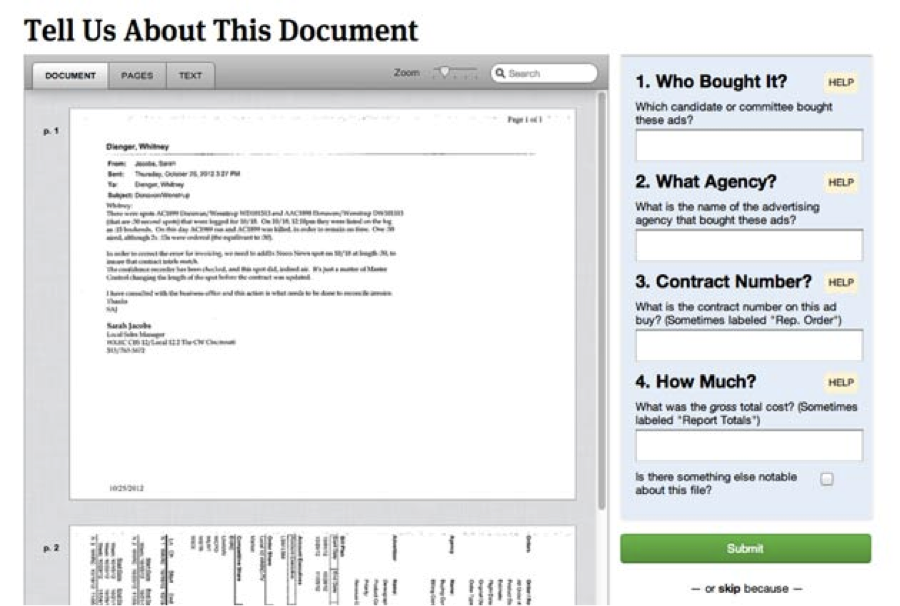
When ProPublica decided to investigate political ad buys in swing states during the 2012 presidential election, for instance, editors knew they couldn’t process all the data on their own. The available data consisted of thousands of unstructured PDFs containing information from different TV stations.
The only way to combine the data to get a picture of who was spending what, where, would be to get people to review the documents and enter the necessary information into a database. The resulting project was called Free the Files. An effort of this size required ProPublica to not only think about how to encourage participation, but also about how they can make the process as open and transparent as possible.
One key decision those involved in the project at ProPublica made right away was to narrow the scope of the project and only focus on specific swing states, rather than the whole country. They also picked a small set of important questions they wanted answered about each document. This gave focus to the task, and limited the time and effort required of participants.
Here’s what the interface looked like for a participant, with the document on the left and the questions on the right:
They also made sure to design a site that immediately showed new and returning visitors the progress that was being made. Disclosing the statistics helped encourage participation.
“When a visitor arrives at Free the Files, one of the first things they see are project metrics: the number of files ‘freed’ and the total ad spending logged by our volunteers,” wrote Amanda Zamora, ProPublica’s senior engagement editor, in a blog post. “These were our success metrics, touted each day to keep the momentum going and spur new participation.”
In an interview, Zamora emphasized the importance of constantly communicating to participants that their work was making a difference.
“Being able to see what your review rate was and where you fit into the overall picture, based on how many documents you reviewed related to your peers, gave people a reason to come back,” she said.
They also built in ways for people to broadcast their participation to social networks, and ProPublica organized “sprint” events to inspire people in a specific geographic area to help free their local files, according to Zamora.
When it was all over, 880 people had reviewed at least one file, logging over $650 million in swing state ad buys. At the conclusion, Zamora identified the top 10 contributors and wrote a blog post to celebrate their effort, and to give each person a chance to talk about why they participated and what they learned.
This reinforces the importance of recognizing, rewarding, and encouraging people as part of the open collaboration process.
V. Encourage people to report errors
One of the ways the public has always collaborated in the reporting process is by speaking up when they see a mistake.
At one time, they would write a letter, or pick up the phone. Today, these requests for correction can flow in by email, on Twitter and Facebook, or via specialized error report buttons or forms offered by news organizations.
Some people are already in the error-spotting habit, but there are easy ways to encourage others to help you eliminate mistakes from your work, while reinforcing that you take accuracy and accountability seriously. (Section five of this study offers advice on doing digital corrections.)
The error report button or form
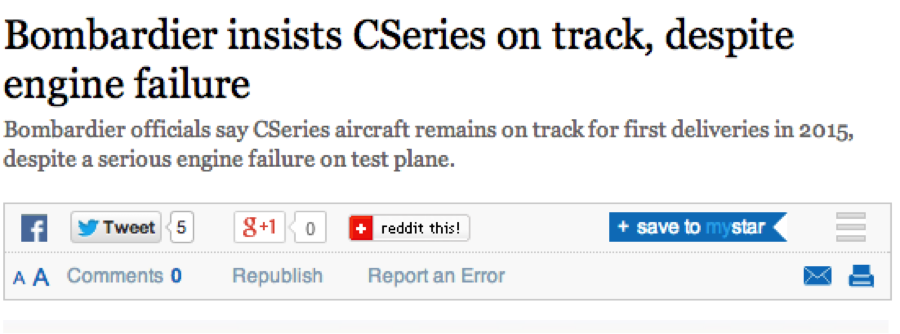
The Toronto Star is one of several organizations to have integrated a “Report an Error” button on all content. It appears in a drop-down drawer that’s part of the Star’s article tools menu, as shown in this example:
A reader clicks on that text and is shown a pop-up menu where they can fill in the details of what they saw:
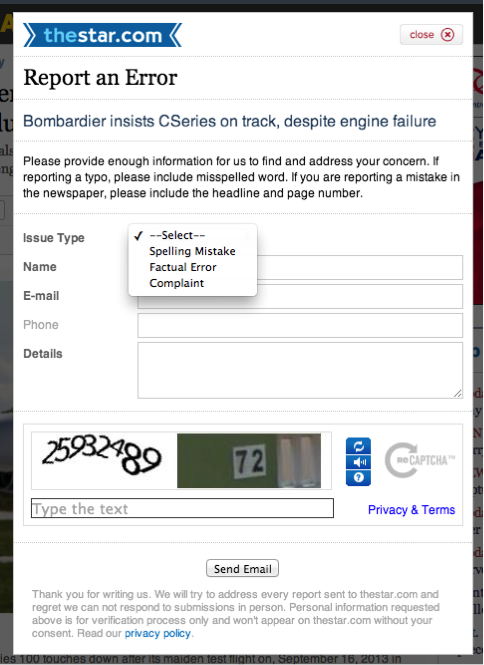
“The idea was to give readers a quick way to point out a factual error to help us act more quickly in catching mistakes, and a simple way for readers to register a complaint about an article,” said Star public editor Kathy English, who added that the form has been part of the site since 2006. “Giving readers such easy means to report errors in effect makes every reader a fact checker working with us to ensure accuracy in the Star.”
English said completed forms are sent directly to her office, enabling her to quickly investigate and correct.
Error report forms have been used by the Chicago Tribune, Columbia Missourian, Washington Post, Huffington Post and Global News (Canada), among other organizations. The forms have a dual benefit of providing evidence of an organization’s commitment to being accountable for mistakes, while also nudging readers to report errors in a consistent and therefore more manageable way.
A form makes it easy for people to understand where to send their requests for corrections, and it also enables the organization to include the necessary fields that help it evaluate the requests.
When the Washington Post launched its error report form in 2011, its then-Managing Editor Raju Narisetti told Poynter, “This increases engagement because we’re being responsive to readers, and there’s significant value in that.”
Canada’s Global News launched an error report button on all content in 2014. Its national director of editorial and online news, Rob Waksman, described the experience for readers:
When you click on ‘Report an Error,’ a form comes up providing visitors with the opportunity to offer a correction or provide additional information and story ideas to enhance our coverage. The feature immediately connects users with the reporters and producers who worked on the story and allows them to make quick corrections.
Crediting and rewarding participation
Each month, Maggie Walter contacts a lucky reader of the Columbia Missourian’s website to let them know that they’ll soon be receiving a prize package from the paper.
Walter, an interactive news editor, runs the paper’s monthly Show Me The Errors contest that rewards one eagle-eyed reader for helping point out typos and factual errors.
“Show Me the Errors invites readers to join the editing staff of ColumbiaMissourian.com and have an opportunity to win prizes,” is how the contest page describes the effort.
To encourage participation, the paper has an error report button at the foot of all content. It encourages readers to submit what they find, and it also explains the contest.
Readers receive one entry in a monthly drawing for each correction request they submit. The contest used to automatically give the prizes — a T-shirt and the copy of a book — to the person who identified the most errors. But that had to change thanks to one prolific error-spotter.
“We consistently had the same winner, and he didn’t have need of so many copies of the same book,” Walter said.
Walter emphasized that it can take internal effort to get staffers to encourage people to point out errors and that consistency is key.
“You need to keep pushing it as much as you can and you have to be positive about it,” she said in 2012. “It feels like people are picking on you when you first start, but you have to remember the people sending these [error reports] are helping.”
She helps reinforce that point by announcing the name of the winner each month in the paper’s “Dear Reader”column.
While the Missourian’s contest is rare, it’s increasingly common for news organizations to credit a name, or Twitter or commenter handle, when adding a correction. The San Francisco Chronicle’s pop culture critic did this when a reader helped him fix an error about an old video game:
CORRECTION: An earlier version of this post suggested that a singular being named Yar was getting his revenge in the Atari 2600 game Yars’ Revenge. In fact, the Yarians were a race of aliens, and were collectively seeking revenge. The Big Event apologizes for the error. (Thanks to TBE reader Marty for the e-mail pointing this out.)
This echoes an approach advocated by Wijnberg of De Correspondent. He said corrections should be expressed with an element of gratitude for the reader who spotted the mistake, rather than with defensiveness.
“The more defensive your attitude, the worse it gets,” he said. “We get a lot of responses from readers when we correct mistakes … We really see people reacting in a very positive way. They actually feel like we listen.”
Establishing a correction workflow
One area where news organizations often struggle is in establishing a corrections workflow that gathers error reports, efficiently reviews them, and results in the proper response. Without one, it’s impossible for an operation to deliver the promise to be consistently transparent or collaborative.
A correction workflow has five core components. In creating a workflow, the goal is to establish a clear path that enables everyone in a newsroom to know their role, and to play it effectively.
1. Collection of requests. Prepare for all of the ways in which people will submit requests for corrections, and think about how you can effectively collect these into a relatively frictionless or streamlined processing queue. Typically, requests for correction will be sent by email to reporters, editors and to general email accounts; via tweets and Facebook comment on a post; by phone; and by people commenting on the piece of content on your website. They will also come in via a form if you set one up.
2. Evaluation of validity. Once received, how will it be evaluated? The New York Times’ Ethical Journalism handbook [PDF] directs reporters to pass requests for correction “promptly to a supervisor.” The more systematic that process can be made, the more consistent and transparent the process can be. This might begin with categorizing the nature of the request. Is this a factual error, or more of a difference of opinion? If it is a claim of error, determine who is responsible for checking it? (This could be done by a corrections guru, an editor or by the reporter.) What guidelines do you have for determining whether a correction is required? Finally, regardless of who does the evaluation, the conclusion must be communicated to the original editor and reporter, in case there is disagreement.
3. Drafting and approval. Many organizations have one unit responsible for writing corrections. Who sees those? How are they edited? As with any content, only more so in the case of one generated by a claim of error, it should be reviewed for accuracy and grammar, and someone should have the final approval before it’s published.The Denver Post directs reporters to speak to a supervisor to discuss and approve corrections:
When an error is discovered – whether it is detected by a member of the public or a staff member – it should be discussed immediately with your supervisor and corrected as soon as possible.
If there is a dispute over whether something is incorrect, a supervisor should be consulted to resolve it. Correction forms should be filled out and turned in to your supervisor.
BuzzFeed’s correction policy is also specific that an editor or team leader must approve corrections:
DON’T add a correction without first running the proposed correction by your editor or team leader. Vertical editors can run corrections by management. And when you approve a correction, please cc management so we can keep track.
4. Publication. The correction is placed on the offending piece of content, in the location designated by the policy. (See section five of this study for advice about correction placement.)
5. Promotion. This is an increasingly important step with digital corrections, and an important consideration when thinking about the intellectual honesty implicit in trying to be transparent. If a fundamental goal of every correction is to help spread the truth, then there is a duty to promote the correction. This can be done by the reporter herself on social media, and also via organization accounts. Part of this process can also include placing the correction on a dedicated online corrections page. This page is where organizations list recent corrections. One way to make this page useful for the public is to have it linked clearly from the homepage. It’s yet another way to demonstrate your commitment to being transparent and accountable. Here, for example, is The New York Times’ online corrections page.
The Register Citizen in Connecticut maintains a blog dedicated to bringing attention to its recent corrections.
“It’s not just about trust, it breeds more accuracy,” DeRienzo said. “If everyone sees that on a regular basis that you are correcting stuff then they will point out things in the future because they know you are correcting stuff.”
Obstacle to Expect and Overcome: Pushback from journalists about the time it takes to interact with the audience. This is a common concern in today’s overworked newsrooms. Wijnberg said the first thing is to communicate that this isn’t “additional work.” It’s part of the journalist’s job. “Basically, they have to find a new balance between what they thought was their full-time job and these new elements,” he said. He suggested that reporters think about when it’s the right time to step back from the interaction and let the conversation carry on (or conclude) on its own.
Share with your network
Build credibility through transparency

You also might be interested in:
Case studies, like the ones in our 2025 impact report, are an opportunity to highlight those findings and spotlight some of the organizations that have partnered with API to collaborate, innovate and advance solutions for their communities.
As research continues to inform this slice of the news industry, we’ll continue learning, too. Who gets to be called a journalist in 2025 and beyond? What is the future of trustworthy information, especially considering the access to and trust for online content creators? How might journalism adapt to the rise, or co-opt the styles, of news influencers?
What if we started looking at our output as a product, not a service? Too often, we think "product" means a fancy app or a new website. But product isn’t about tech. It’s about intention.


