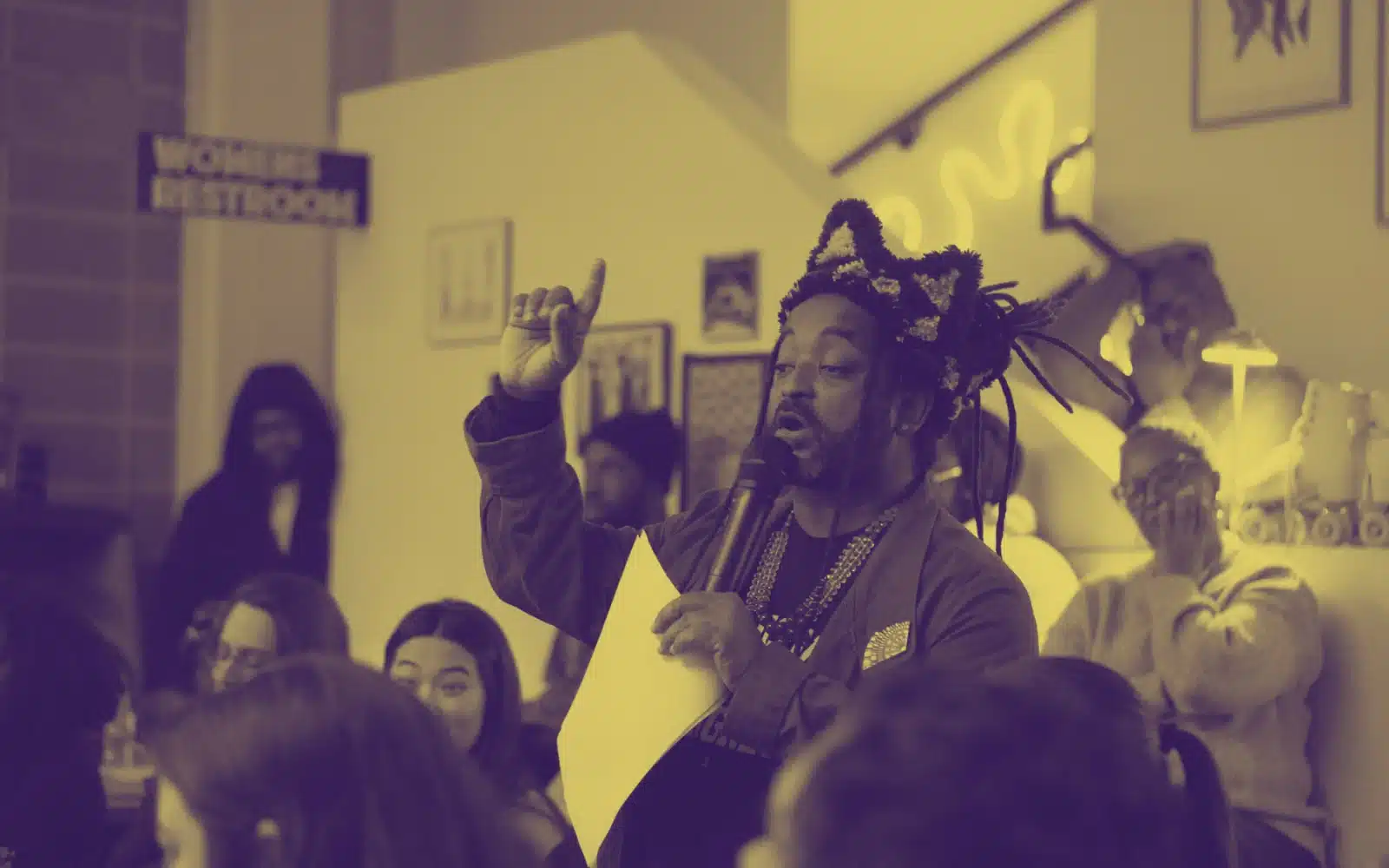
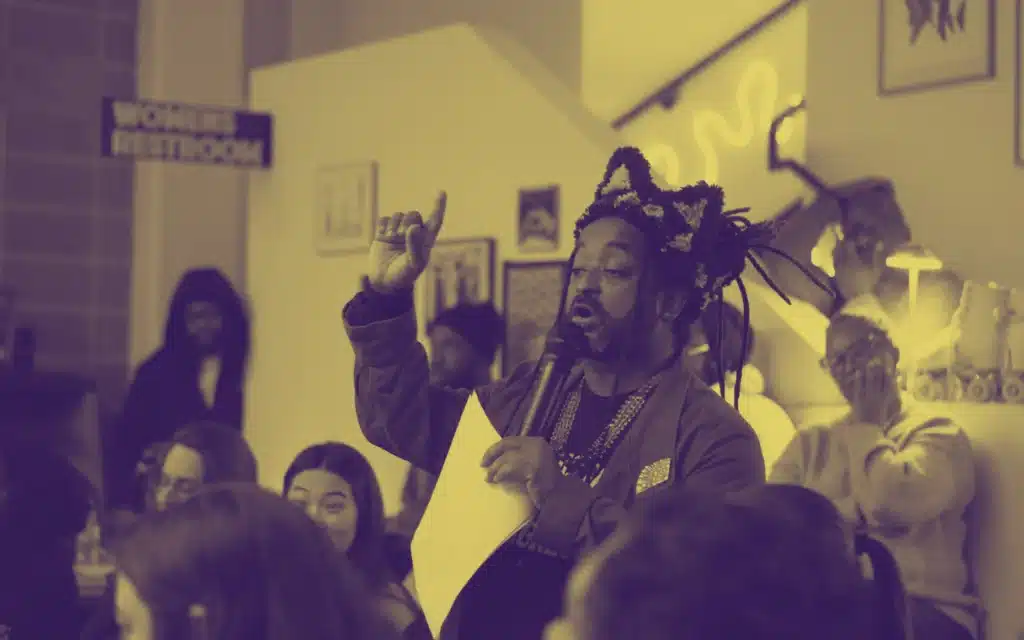
Dwayne Lawson-Brown speaks at the Ask A D.C. Native, Live! event (Ian Hutchinson)
On a Monday evening in downtown Washington, D.C., about 40 people gathered in a coworking space lined with striking portraits of children by a local mixed media artist and educator. While the crowd was mostly adults, they were being taken back to school that night.
This was the first edition of the trivia game show Ask A D.C. Native, Live!, which took place in May — the week of D.C. Native’s Day. The event is based on a column for The 51st called Ask A D.C. Native, which gives native Washingtonians, like myself, an opportunity to serve as experts, cultural preservationists and historians of a city that’s often associated more with its transplants than people who grew up here.
The game show was hosted by Dwayne Lawson-Brown, who was a guest at a panel featuring D.C. creatives that I curated a few years ago. Dwayne grew up in the city and hosted Spit Dat, D.C.’s longest-running open mic night. More importantly, they’re a trusted messenger — someone who has credibility, authentic relationships and lived experience — among D.C. natives and Black residents, who can be skeptical of local media.
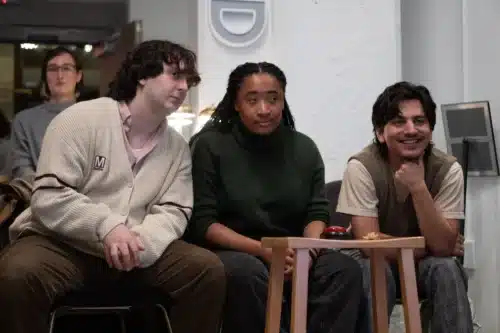
Attendees at the Ask A D.C. Native, Live! event (Ian Hutchinson)
Dwayne was the first — and only — person I thought of to host the event. I didn’t have money to pay them, and The 51st, which only began publishing seven months earlier, did not have much of a reputation. So pitching the hosting gig was a long shot.
Fortunately, Dwayne happens to love trivia — and, of course, D.C. — so they were thrilled to host for free. They were also intrigued by the idea of a worker-led, local news outlet that billed itself as being for D.C., by D.C. residents.
That evening, Dwayne posed questions to two competing teams in categories such as “D.C. High Schools,” “History and Politics” and “That Joint Crank,” which featured snippets of songs from local musicians. The winning team and audience contestants were gifted tickets to upcoming shows at local theaters and gift cards to D.C.-based businesses.
For guests unfamiliar with The 51st, the event offered an introduction in a space that was fun, engaging and warm. 51st team members shared information about our newsroom and asked attendees what they wanted from local news.
In a recent blog post, Dwayne shared how they felt after hosting the event.
“It was a blast. The venue, the audience, the contestants — everyone wanted more trivia. But I wanted something else. I didn’t want to be a guest, hosting for this group; I wanted to be part of the team. I saw news in action, people building something that felt organic and focused on integrating the community, not just reflecting it via news coverage.”
I told Dwayne about The 51st’s Community Connector program, which launched in December 2024. By hiring (as contractors) people who genuinely connect with certain groups, the program bridges our news outlet and the communities we’re trying to reach. Our first Community Connector was George Kevin Jordan, a writer, artist and Ward 7 resident. In June, we expanded the Community Connector program with Dwayne to connect D.C. natives to The 51st.
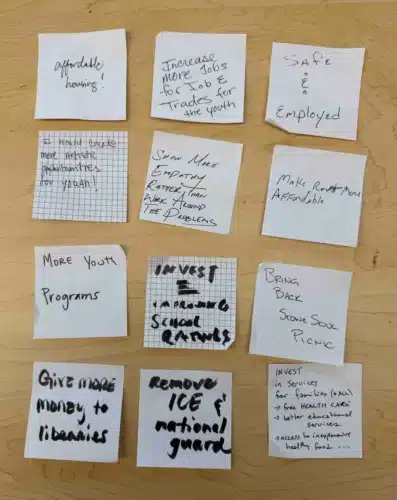
(George Kevin Jordan)
When we founded The 51st, we wanted to lead a news organization shaped by D.C. residents. And the Community Connector program has become an integral way of doing so.
We started with Ward 7, a majority Black area that’s home to 90,000 residents (as of 2023), spread among about 28 neighborhoods. It has some of the widest social and economic disparities in the city.
As the Community Connector for Ward 7, George has tabled at community meetings and farmers markets, hosted events like an ice cream pop-up outside of a neighborhood library, distributed an information-gathering survey and sat down with residents one-on-one to learn how The 51st’s reporting can reflect and enhance their daily lives. When tabling, he often poses fun questions like, “’What’s the first thing you would do if you were D.C. mayor?’
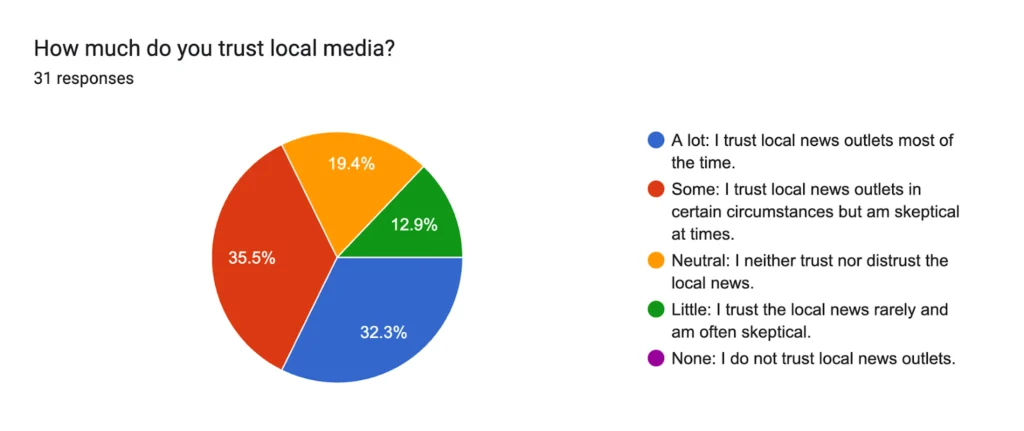
He also updates our readers with blog posts, transparently reporting his findings. For instance, when asked how local news outlets cover their communities, here’s what he heard from his survey respondents:
- 38.7% said the coverage is insufficient or that the ward is rarely covered
- 29% said news coverage focuses too much on negative stories
- 12.9% of respondents said news coverage is fair but lacking depth or nuance
Meanwhile, about 68% of respondents said they have at least some trust in local news outlets, about 32% said they usually have a lot of trust in local news, and nearly 13% said they have little trust in local journalism and are often skeptical.
Courtesy of The 51st
One of his main insights is that to bridge the trust gap, Ward 7 residents want to see their communities reflected in our news coverage. So, The 51st’s editorial team made a point to prioritize Ward 7 pitches. We created a tag on our website to track those stories for easy access and accountability, and we’ve published about a dozen Ward 7 stories since the program launched.
With a grant from the Listening Post Collective, George is now expanding his work by hiring two new Community Connectors — one person to participate in in-person events and another person to facilitate digital outreach, ultimately developing an Information Ecosystem Assessment that can inform future programming and outreach.
Courtesy of Dwayne Lawson-Brown
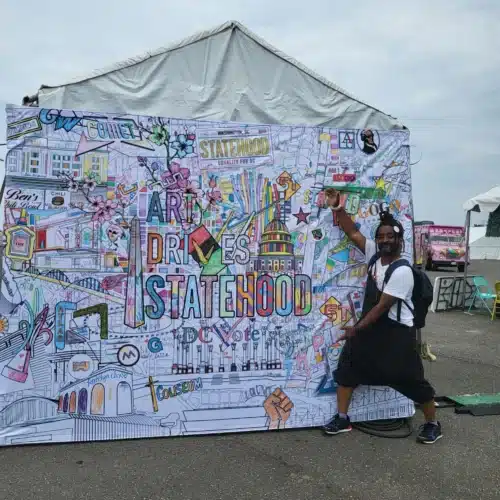
For Dwayne, we created a version of the Ward 7 survey that was unique to native Washingtonians, and they have distributed it at local events and festivals. Dwayne also launched an Instagram video series highlighting D.C. natives involved in political, social and creative work. Meanwhile, they continue to host Ask A D.C. Native, Live!, with the second edition in September drawing twice as many attendees.
Tips for working with trusted messengers for community engagement
While our Community Connector program is very much in its infancy, we have some early insights for newsrooms seeking to work with trusted messengers to engage with news avoiders and other target audiences.
Look within your network. For newsrooms just embarking on a program like this, it’s smart to start with people you already know and trust. Both George and Dwayne were in our ecosystem. We knew their character and communication styles, and we were confident they had deep and meaningful ties to the audiences we wanted them to reach.
Map out people in your orbit — sources, community partners, freelancers, volunteers, longtime readers — and see if they identify with people within your target audience.
Promote their strengths. While some of their goals and tactics are similar, we’ve allowed each of our Community Connectors to curate their own work plans. George was excited about chatting with neighbors one-on-one and hosting listening sessions with small groups, while Dwayne saw the value in creating video profiles of D.C. natives. When trusted messengers can lean into their natural communication styles, expertise, and lived experiences, they will be most effective and authentic.
Set goals and metrics. Even though their work is relationship-driven, we structured work plans with clear and measurable goals. In each Community Connector contract, we spell out deliverables, timelines and communication expectations. These metrics help everyone — from our Community Connectors to our editorial and operations teams — to stay on the same page.
Be transparent and iterate. Community engagement isn’t linear, so be open and flexible in this work. Early on, George found that getting people to complete a long survey from an organization they had never heard of was a challenge. So we created a shorter survey, in addition to new engagement tactics, based on how familiar people are with our news outlet. Not only were we transparent internally, but we also shared this with our readers.
“Building relationships, whether friendships or community connections, takes time. There is a lot of trial and error along the way,” George wrote in a blog post. “Just saying I’m a journalist and community connector doesn’t mean residents will automatically feel compelled or even interested in sharing their thoughts. Trust and buy-in from Ward 7 residents, especially in this climate, will understandably take time. We have to continuously engage until we become a fixture in their lives.”
Apply for funding specific to the program. As your initiative grows, treat it as its own line of work that deserves dedicated resources. Funders are interested in community engagement and audience development, so take advantage of that when building out your newsroom’s fundraising plan. Keep track of your wins, challenges and impact to include in funding applications.
Broaden your search for trusted messengers. Once you have a solid footing, you can look for trusted messengers beyond your inner circle. With our Listening Post expansion, George created job descriptions for two new Community Connectors. This was a chance to cast a wider net and open the program to new voices that reflect more of our target audience, not just people closest to us.
Christina Sturdivant Sani is the Executive Editor at The 51st. She’s freelanced for more than a dozen publications, highlighting Black life and culture in Washington, D.C. and unpacking issues faced by marginalized communities.
Share with your network
4 ways to partner with community expertise and talent to strengthen local journalism
You also might be interested in:
We asked four summit participants to share more about the ways they are defining, measuring and acting on signals of impact.
Whether it’s an engaging personality breaking down complicated news on YouTube, a streamer testing their limits on an obstacle course or a short film series that meets people where they’re at, content consumption is fragmented — but also gives newsrooms an opportunity to create niche content that can succeed if paired with the right distribution strategy.
If you want to know how to reach teens and young adults, ask young journalists and the folks who work with them.


