News avoidance, fatigue and information overload raise big questions for local news leaders — about attention, trust, digital wellness, relevance, belonging and revenue. And those questions are playing out within a larger negotiation over how people want technology and information — including our lives as journalists — to fit into their lives. Recent Pew Research Center data found that 53% of Americans say they spend too much time on their smartphones and 45% have tried to cut back in the past year — even as 73% say their smartphone helps keep them informed.
Add to this that “avoidance” can stem from many different things: lack of relevance, friction, habit, distrust, competing priorities, emotional self-protection. A big label can tempt us into an overly broad or reactive response.
For leaders already operating with limited time, money and attention, the challenge is two-part: first, generating potential solutions to the problems, and then deciding which of those responses or ideas are worth acting on — and what they need to learn before they do.
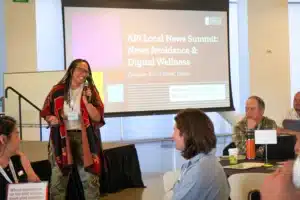
Photo by Marita Pérez Díaz/API
What the 60 news leaders convened in Boise, Idaho, for API’s Local News Summit on News Avoidance and Digital Wellness seemed to take away was permission to shrink the intervention without shrinking the ambition. This room had no shortage of good ideas, as most rooms of journalists do. But the room did lack bandwidth, staffing, resources and evidence back home.
The summit shared plenty of new ideas, including products, events, audience strategies, and even workflows, partnerships, and investments — all of which asked the newsroom to commit already-stretched resources. Rather than let those join a pile of possibilities already competing for leaders’ limited attention, we asked them to slow down just enough to interrogate which ones were worth acting on. Because a good idea isn’t yet a good decision.
This isn’t an argument for more caution or slower newsrooms. It’s an argument for increasing our capacity for change and making operational and organizational decisions amid deep, constant uncertainty. If we can improve the quality of the thinking that comes before a commitment — without dramatically increasing the cost, in financial and human resources, of deciding — we can spend less time and money learning things too late. And that can create more room to experiment, adapt and take informed risks.
To do that, we asked leaders to slow the leap from idea to investment with four questions:
- What must be true?
- What matters most if we’re wrong?
- What do we know and where are we guessing?
- What’s the smallest version to learn from?
What must be true?
To reach, relate to and retain audiences with defined boundaries between their wellbeing and information consumption habits, newsrooms should be asking what interactions would actually feel useful, manageable and worth returning to — instead of asking how to get more people to engage more often and with more news.
Before deciding whether an idea to mitigate news avoidance and support digital wellness — or any industry challenge — deserves investment, get clear about the value or experience you hope it creates. Then, ask: what would have to be true for that to happen?
The goal here isn’t to talk ourselves out of an idea. It’s to understand what we’re betting on when we say yes to it. For example, if the intended experience of a live event is to give people who feel disconnected from local journalism a more human doorway into news and information, then what must be true?
That means asking whether the people you hope to reach would actually choose to attend — and whether the invitation even reaches them. You may be assuming that the event feels participatory rather than extractive, that your newsroom has capacity to make the experience good enough to return to, and that this new relationship or connection has somewhere to go afterward (not just a daily newsletter of headlines).
Consumer behavior research offers a useful check here: start with what the person is trying to accomplish, then work backward to what they might “hire” your journalism to help them do. Likewise, research on news avoidance offers a similar caution. Whether people engage with news is not only a question of content. It’s also shaped by identity, habit and how news fits — or doesn’t — into everyday life.
Both matter. The research suggests that journalism’s value proposition must be clear because our community isn’t only deciding if journalism is relevant, but they’re also deciding how, when and whether it fits into the routines they are building around information.
Once the assumptions are visible, the next question is less about whether they’re all true and more about which one matters most if we’re wrong.
What matters most if we’re wrong?
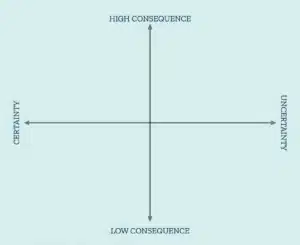 Once you start naming assumptions, the list can grow quickly, but not every assumption deserves the same attention. Instead, consider:
- How uncertain are we that this is true?
- And how consequential would it be if we were wrong?
To narrow down the assumptions in the live event example above, consider which would be most uncomfortable to discover was wrong after you’d already invested six months and $25,000.
When plotting uncertainty against consequence, the point is to direct scarce attention toward the uncertainty that could most change the decision.
What do we know and where are we guessing?
Once you know which assumption deserves your attention, take stock of the evidence already underneath it. What do you really know — and where are you still guessing?
A useful way to start is by sorting what you believe into three buckets: what you know, what you think and what you hope.
- We know because we’ve observed, heard, measured or learned something.
- We think when we are making an interpretation or offering our current best explanation.
- We hope when we are naming something we want to become true.
These distinctions can blur easily in newsroom decision-making. “Our audience doesn’t want that.” “Young people won’t pay for news.” “People will come if we host this.” “Events don’t scale.” Statements like these may contain real insight, but they can also make interpretation or aspiration sound more settled than it is.
We don’t want to eliminate thinking or hoping as we increase our decision-making capacity. Both matter. Instead, our goal is to notice what kind of claim you’re making before you organize resources around it. One way to strengthen this “know” column is to replace what we imagine about people with what they’ve actually told, shown or demonstrated. Decisions get stronger when leaders can distinguish between evidence from the community and a story the newsroom is telling itself about the community.
You don’t need perfect certainty before acting, but you should know whether what’s guiding the decision belongs in the know, think or hope bucket — and be willing to move it when new evidence arrives.
What’s the smallest version we could learn from?
In a digital news environment already competing intensely for people’s attention, the smallest useful learning move is important. This is where you resist the urge to immediately build or launch a thing. In staying small and feasible, you’re more likely to learn something that would make a larger commitment feel meaningfully less uncertain.
If you’re considering a new event series, good. Stop there and consider all the ways you could learn without ever hosting the event:
- Test the invitation
- Talk with a dozen people you hope would come
- Ask people who didn’t engage in a similar effort why
- Observe how people currently solve the problem you think the event will address
- Look back at an earlier initiative that failed
- Talk to another organization that’s already encountered the risk you’re worried about
These aren’t smaller ambitions. They’re smaller commitments. Sometimes, the proportionate learning move is research before action. Sometimes, it’s a deliberately small pilot.
In Boise, participants were trying to strengthen community connection, make journalism easier to encounter, create healthier ways to engage and build relationships people might return to. But they gave themselves permission to think small and to prioritize feasibility. Here’s what that looked like:
- One newsroom open house
- Two low-fi Article Clubs
- One or two QR placements
- One manually sent newsletter
- One trust event pilot
- An annual collectible print product rather than a weekly one
This is proportionate learning for news leaders — choosing a learning move sized to the uncertainty before making the next commitment. It can both protect our capacity and create more of it. The sooner we learn whether an important assumption holds true, the sooner we can invest with greater confidence, change direction or stop altogether.
Smaller bets can also increase our willingness to take informed risks because less depends on any one of them being right. That matters in a field where experimentation can feel expensive, exposing and hard to justify.
***
News avoidance is complicated. News organization capacity is scarce. Digital wellness asks us to rethink whether “more” is always the goal. That question shows up elsewhere in the information ecosystem, too. New_Public’s work on healthier digital spaces asks if people participate, whether they feel their time was well spent and if an experience strengthens agency, belonging and social trust.
Maybe that question belongs inside our newsrooms, too.
More ideas, more initiatives, more reach, more time spent — none of these guarantees more value, more experimentation, more attention or more capacity for change. What can create capacity is getting better at knowing what deserves our limited attention, what we need to learn next and how little we may need to spend to learn it.
A good idea isn’t yet a good decision.
Our ambition can remain large: healthier, more valuable relationships with news. But the next learning move can stay small enough to help us learn and adapt sooner, creating more capacity for whatever needs to change next.
Try it: A 5-minute “Quality of Thinking” Routine
Pick one idea currently competing for your attention and use that idea for the routine below.
- Experience (1 minute): What do we hope becomes different for people?
- Assumptions (1 minute): What would have to be true for this to create value? Then, sort quickly: Know/Think/Hope
- Move the camera (1 minute): Choose one assumption:
- Imagine this didn’t work. What turned out not to be true?
- Or: What if the opposite were true?
- Map (1 minute): Which assumptions are both uncertain and consequential if wrong?
- Learn (1 minute): What is the smallest way we could learn enough to make the next commitment less uncertain?
Tip: Use this routine before you commit time, money or attention to any promising idea.
You might also be interested in:
Through working with local news organizations and teams via coaching, programs and research, the American Press Institute has seen how outlets build resilience through interpreting data and evidence together, making informed decisions and adapting to what isn’t working.
When the tools, economics and expectations around AI are all still moving, knowing where you actually stand is a far better place to lead from than false confidence or uncertainty.
There are three tactical ways local newsrooms can be the conveners for their communities: designing for human connection, designing for everyday usefulness and designing for joy, curiosity and surprise.


