
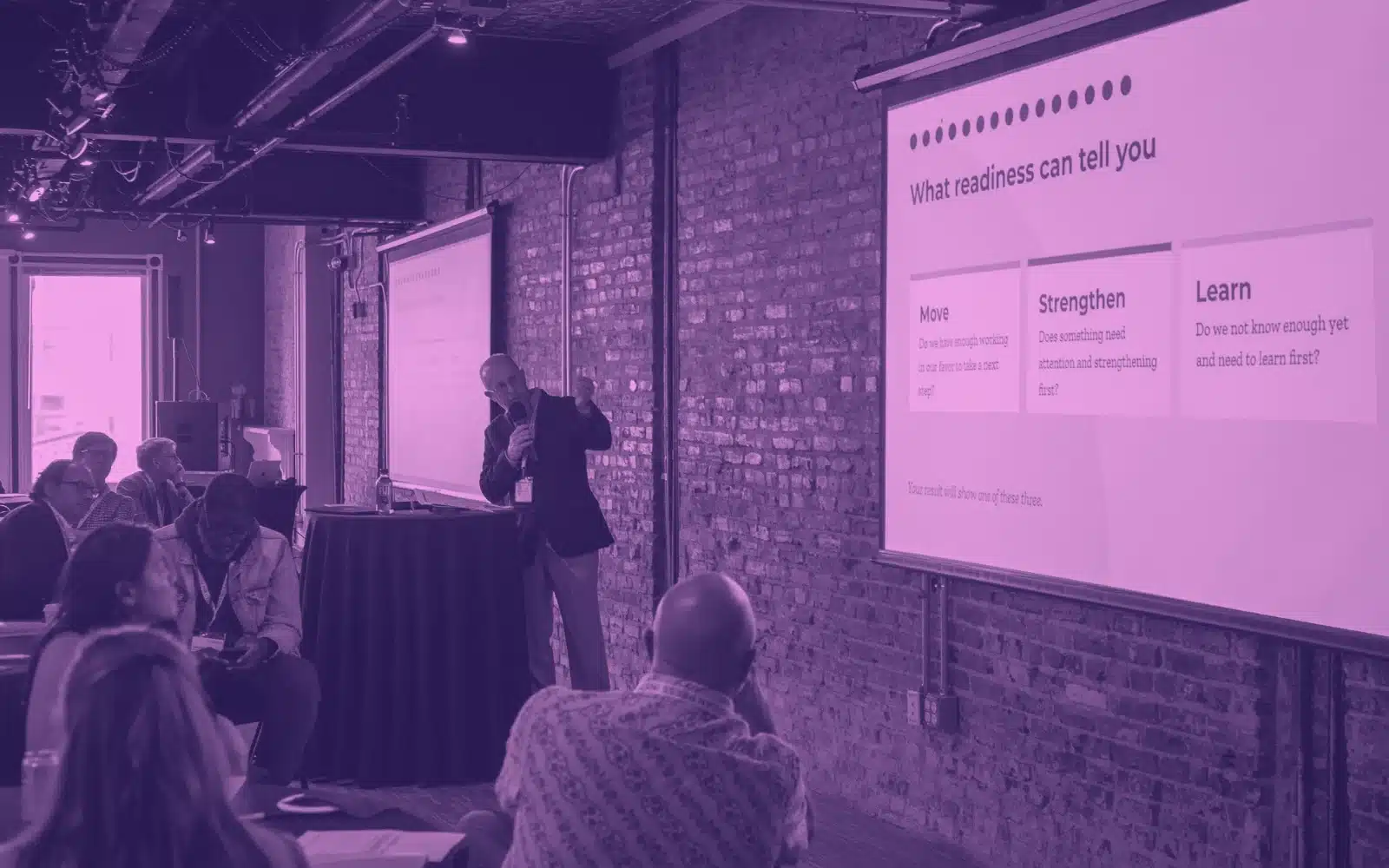
If you feel like your newsroom is just getting started with AI, here’s something worth knowing: so does nearly everyone else.
That’s what we heard from more than 50 local news leaders during our half-day AI in Leadership Retreat last month. The room held a real range — some leaders run organizations with dedicated teams and AI experiments already in motion, while others are figuring out what to try first. Yet by the closing conversation, leader after leader landed on the same realization: They’re at the beginning of this journey, not the end.
That isn’t a sign of falling behind. When the tools, economics and expectations around AI are all still moving, knowing where you actually stand is a far better place to lead from than false confidence or uncertainty.
The retreat ran under the Chatham House Rule, so we won’t name participants or their organizations. What we can share are the frameworks that shaped the afternoon, and a few things you can try with your own team this month.
Start with what gets better, and for whom
 Samantha Ragland, API senior vice president, opened with a reframe that sounds simple but isn’t: The use of AI isn’t the end goal. Making something better for somebody is.
A lot of newsroom AI conversations run in the other direction. They start with a vendor demo, or a tool someone saw on LinkedIn, and work backward toward a reason to try it. Flipping the order changes what you end up talking about.
- A transcription tool isn’t the goal, but reporters getting hours back for source work might be
- An AI summary feature isn’t the goal, but finding what readers need faster might be
One thing to try: Before your next AI conversation with your team, write down what you are trying to make better, and for whom. If either answer takes more than a sentence, you’re probably not ready to talk about tools yet.
Identify the friction points underlying a challenge
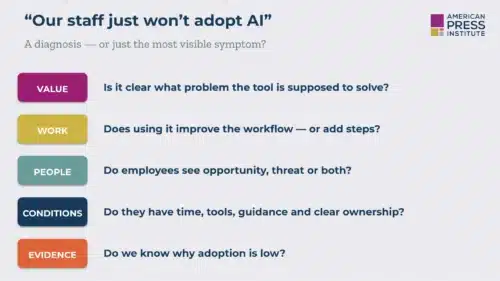
Before the retreat, participants submitted the core challenges they face around AI implementation, such as identifying where AI can bring the most value, moving from experimentation to adoption or navigating staff trust. While the challenges are different, the underlying leadership questions are the same, said Robyn Tomlin, API executive director. She gave the room five lenses for seeing the system around a challenge and identifying friction points:
- Value: Are we clear on the outcome our organization needs, or mostly excited by the technology?
- Work: Have we made real room to iterate, or is the team already past capacity?
- People: Is staff curious and engaged, or skeptical and anxious?
- Conditions: Are leaders aligned on guardrails and on what we won’t compromise?
- Evidence: Will we see a clear signal soon, or is success vague and months away?
These aren’t concrete steps to solving the challenge, Tomlin clarified — they’re five ways to look at the same challenge. That distinction stuck. In early survey feedback, attendees called out the lenses specifically because they weren’t a sequence. Steps imply a finish line, but lenses let you look at the same problem from several angles and catch what you’ve been missing.
The most useful insight often lives between the lenses, where two of them pull against each other. A staff can be genuinely eager to experiment and already stretched thin. Both things are true at once, and leading through that tension is the actual work to be done.
One thing to try: Finish two sentences about a challenge you’re facing: “I’ve been most focused on…” and “I may be underestimating…” Then ask a colleague to do the same about the same challenge, and compare notes.
Borrow a second set of eyes
Once they got insights on what might be causing AI adoption roadblocks, leaders shared their challenges in small groups, using a consultation structure that kept feedback curious rather than prescriptive. Consultants could respond in only three ways: “We notice…,” “We wonder…” and “Something you may be underestimating is…”
It’s a small constraint with an outsized effect. Nobody jumps to “here’s what you should do,” which keeps the person with the challenge thinking instead of defending.
One thing to try: The next time you meet with a colleague or team to discuss your AI challenge, ask them to use those three prompts for 10 minutes before any solutions come out.
Figure out what your readiness is telling you
The final session, which I led, moved the room from diagnosis to readiness. The question shifts from “what’s shaping this challenge?” to “what does that tell us about our ability to actually move?”
We identified three types of readiness:
- Move: Enough is working in your favor to get started
- Strengthen: Something needs attention first
- Learn: You don’t know enough yet
That last one matters most. Not knowing enough yet isn’t failure. It’s information that can tell you what you need to know to act.
Using an AI tool I built for the exercise, participants submitted an AI move they wanted to try to gauge their readiness. The tool identifies which of the five lenses is strongest for the idea, as well as where to build from and a question to ask collaborators.
For example, if an editor wanted to incorporate AI into meetings to create agendas and transcribe for beat reporters, the tool might highlight strength in the Value lens — there’s clear value to be gained in an editorial sense. But the Work lens might score lower because nobody has the bandwidth to learn this new process. The tool would prompt the editor to solve for that discrepancy — what current task could they remove to allow for two hours of learning?
I built the Leadership Move Stress-Tester without writing code, treating an AI app platform as a general contractor while I played the owner monitoring the project. One attendee told me afterward they’d cycled through plenty of analogies for AI, intern and assistant among them, and this was the one that stuck. The contractor builds, but the owner still decides what the house is for.
There’s a lesson in how the tool got built, too. Early in testing, it told someone they were wrong about where they’d been focused. They weren’t. I just hadn’t asked a good enough question. When a tool, a dataset or a colleague disagrees with you, pay attention to what you do next.
One thing to try: Pick one AI move you’re weighing. Rate yourself honestly on each of the five lenses — where you actually sit, not where you wish you sat. Then find the two answers that pull against each other. That’s where your leadership attention goes first. Try the tool for yourself here — the data is all anonymous.
Starting is the point
None of these frameworks promise a finish line, and that’s by design. The leaders in that room didn’t leave with a finished AI strategy. They left with better questions, a clearer sense of where they stand and permission to call the beginning what it is.
If that’s where you are too, you’re in good company.
The conversation continues this fall as API works with retreat participants through a solutions sprint in the coming months, and we’ll share more on what the news leaders learn through their projects.
You might also be interested in:
There are three tactical ways local newsrooms can be the conveners for their communities: designing for human connection, designing for everyday usefulness and designing for joy, curiosity and surprise.
How do we bridge that gap between the standard KPIs and those mushier signals of your work’s impact — how can you identify and quantify what’s changing in the lives and perceptions of the communities you serve?
We asked four summit participants to share more about the ways they are defining, measuring and acting on signals of impact.


