
Local news has become remarkably confident in measuring what it publishes and produces, but a bit less certain about measuring what it changes.
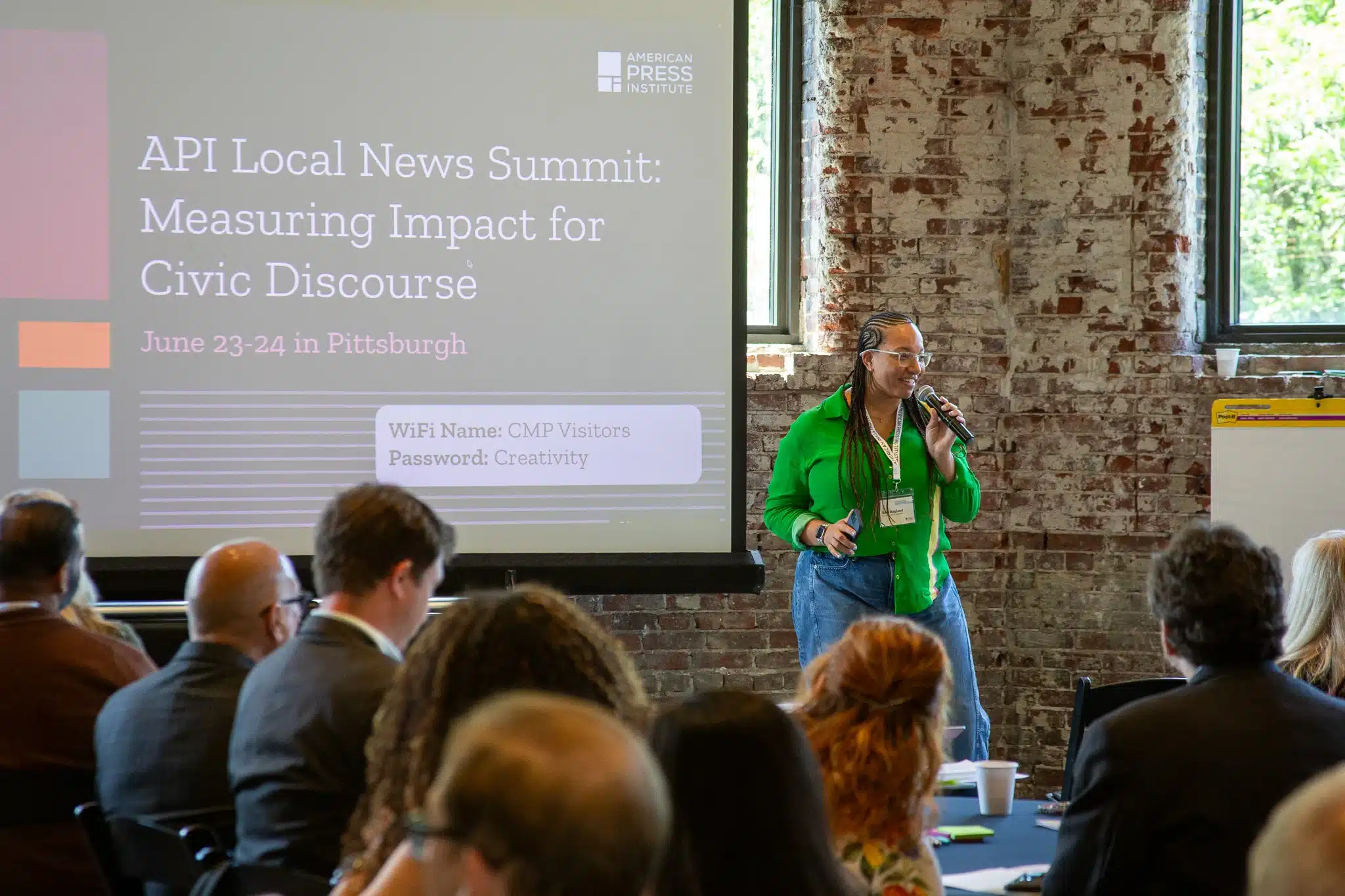
Sam Ragland speaks at the recent API Local News Summit in Pittsburgh. (Photo by Lilly Chapa)
Instead of trying to figure it out alone, 70 news practitioners from across business models, disciplines and roles convened in Pittsburgh alongside researchers, community organizers, educators and philanthropists. Together, at this American Press Institute Local News Summit, they owned this gap and charged ahead to explore the signals of impact that occur before the outcomes we hope our journalism creates.
API didn’t push a new metric or a universal framework, but participants still left with new questions and vocabulary, conversations on the calendar and several practical ways to turn impact information into better newsroom decisions.
Impact as a practice is for commercial and start-up news organizations as much as it’s for newspapers, local broadcast and public media. It’s for creator journalists and beat reporters, too. Because when we can consistently notice, interpret and improve our public value as information stewards, we’re better positioned to earn trust, attach investment, make wiser strategic choices and grow impact over time. And this is a stronger, more durable story than simply measuring another KPI.
Here are three shifts in how journalists and news leaders like you can see impact differently, build better impact practices, and turn impact into better decisions — each inspired by summit participants with complementary experience, gathered in a space designed to foster creativity and shared ownership.
Want to try this out with your team? Use this worksheet exercise to take your newsroom’s impact pulse in 15 minutes.
See impact differently
If you were to ask each member of your news organization to craft a six-word “impact” story, you’d get just as many types of impact as you have people in the room. And that’s the first step — acknowledging that impact is plural.
In fact, an informal analysis of more than 200 API Local News Summit attendee surveys, including from our most recent summit on measuring impact for civic discourse, found that there isn’t a single type of local news impact.
We saw 12 themes emerge, instead. They describe changes in people, communities and inside the newsroom itself.
| Knowledge | Understanding | Learning |
| Trust | Relationships | Representation |
| Community action | Convening | Belonging |
| Newsroom learning | Sustainability | Public value |
To see impact differently, we have to expand what counts.
Traditionally, journalism has sought to “speak truth to power,” “to hold the power to account,” “to give voice to the voiceless.” But the news around us has gotten louder, noisier and harder to distinguish from other forms of information — not to mention the residents we serve have new, sometimes unexpected information needs. So, we must grow adept at noticing the invisible signals of impact that our journalism creates: a resident returning with a neighbor to a community conversation, a source who once avoided the newsroom now reaching out first, a volunteer who becomes a civic leader or a small business owner donating their venue for a news event.
To measure what you’ve never learned to notice, you have to move beyond outputs alone to better observe and capture what’s changing in the lives and perceptions of the communities you serve.
We have to be aware that our attention becomes our compass — what we choose to notice will ultimately shape where we go next.
🔎 What this looks like in the newsroom
One news leader at the summit said their for-profit newsroom is broadening what it chooses to notice, paying closer attention to the ways journalism deepens community relevance and demonstrates long-term public value.
🧪 Try to notice today
Ping five people in your newsroom, asking them to independently finish this sentence:
When I think about the impact of our journalism (or beat, or department), I think about…
💬 Consider what you heard
Take five more minutes of your attention: Where is there overlap? What kinds of impact didn’t come up? What kinds of impact might be there but aren’t yet noticed, tracked or learned from?
Build better impact practices
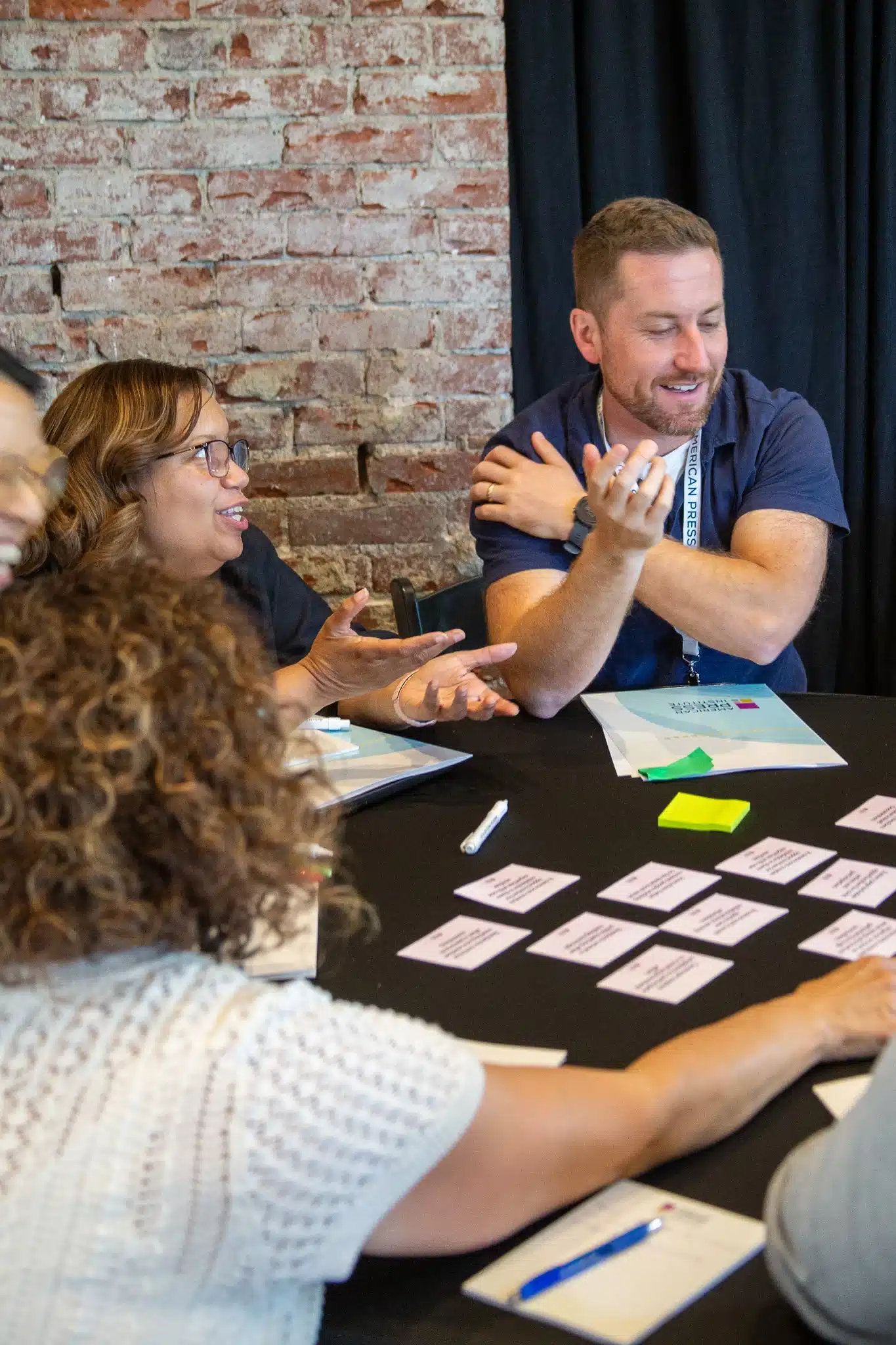
Summit attendees sorted impact scenario cards to identify different types of impact. (Photo by Lilly Chapa)
Organizations don’t learn because information exists. They learn by building routines for interpreting information together. They learn because everyone is responsible for a piece of the conversation or the outcome.
Impact can’t belong to your engagement team or to fundraising, analytics or even that one enthusiastic editor. If impact truly lives in 12 different places, no single person can own it. It has to become part of how everyone plans, reviews and improves the journalism — from the broadcast and the investigation to the live events, news products, sales and grantmaking.
Organizations make impact a habit through simple routines, newsroom rituals and points of connection:
- Begin projects by asking what change your reporter is hoping to create
- End reporting by asking what surprised you
- Invite people from outside of journalism to interpret what you’re seeing
- Protect space to interpret and learn from your impact signals
- Translate what you’re learning for the audiences that matter (e.g., staff, funders, advertisers, boards, communities, etc.)
🔎 What this looks like in the newsroom
A statewide news organization represented at the summit has built impact into the reporting process rather than treating it as something evaluated only after the work is finished. Major projects include conversations with the chief impact officer about the change the reporting team hopes to create.
🧪 Try to share this week
Choose one recurring meeting this month. Add a five-minute impact conversation by asking: Notice: What surprised us? Interpret: What might it mean? Learn: What is that teaching us? Adapt: What should we do differently?
💬 Facilitate the conversation
Start with Post-its for each question, and ask everyone to contribute before opening the discussion. Look for patterns before drawing conclusions from individual examples. Make room for disagreement, which often reveals our hidden assumptions. Use language like “Tell me more” and “What else might this mean?” End by agreeing on one thing to keep watching and one change to test before the next month’s meeting.
Turn impact into better decisions
The point of impact isn’t to prove your value. It’s to help you make better decisions about where to invest your time, reporting and social capital next.
Most news organizations already collect far more data and information than they can act on. They know which stories were published, how many people visited their site, who attended an event or who subscribed to a newsletter. But information alone rarely changes an organization. It’s what happens after that data has arrived that changes coverage, distribution and subscriber acquisition.
The strongest organizations treat impact as a learning system rather than a reporting requirement.
Rather than waiting for grant reports or annual reviews, these organizations build habits that help them notice what their communities are responding to, interpret what those signals might mean and adapt their journalism while the work is still unfolding. They embed an impact learning loop through active inquiry and experimentation. Ambassador networks, volunteer pathways like Documenters, community advisory groups or even dismantling beat structures in favor of communities of interest — these are systems for learning as much as they are engagement strategies.
Ultimately, the value of impact data, and of even reading signals of impact more consistently, isn’t to prove our value as stewards of news and information. The value is in understanding how we create value so we can create more of it.
🔎 What this looks like in the newsroom
Rocky Mountain Public Media’s Ambassador64 initiative is building a learning system that illustrates this shift. Rather than relying solely on audience metrics, the organization is experimenting with a statewide network of community ambassadors to understand emerging issues, community priorities and patterns of participation that help inform future editorial decisions.
🧪 Try to adapt this month
Choose one reporting project that’s still underway. It could be an investigation, a video series, live event series or even a news product like your mobile app, a newsletter or an interactive database.
💬 Practice the learning loop
Instead of only asking “how is it performing?” ask: What are we learning? What assumptions have changed? What decisions should we change because of what we’re seeing and making sense of?
Remember: Impact is both plural and iterative. Practicing the learning loop with your team means you’re no longer waiting for someone else to draft the grant report or annual impact report. You’re learning while the work is still alive.
Gratitude goes to the Kiplinger Program in Public Affairs Journalism as one of several supporters of our API Local News Summit on Measuring Impact for Civic Discourse. Their support expands public-facing resources like these we can make from this gathering. And if you are interested in measuring the impact of local news, or API’s Local News Summits, let us know.
You might also be interested in:
There are three tactical ways local newsrooms can be the conveners for their communities: designing for human connection, designing for everyday usefulness and designing for joy, curiosity and surprise.
How do we bridge that gap between the standard KPIs and those mushier signals of your work’s impact — how can you identify and quantify what’s changing in the lives and perceptions of the communities you serve?
We asked four summit participants to share more about the ways they are defining, measuring and acting on signals of impact.


