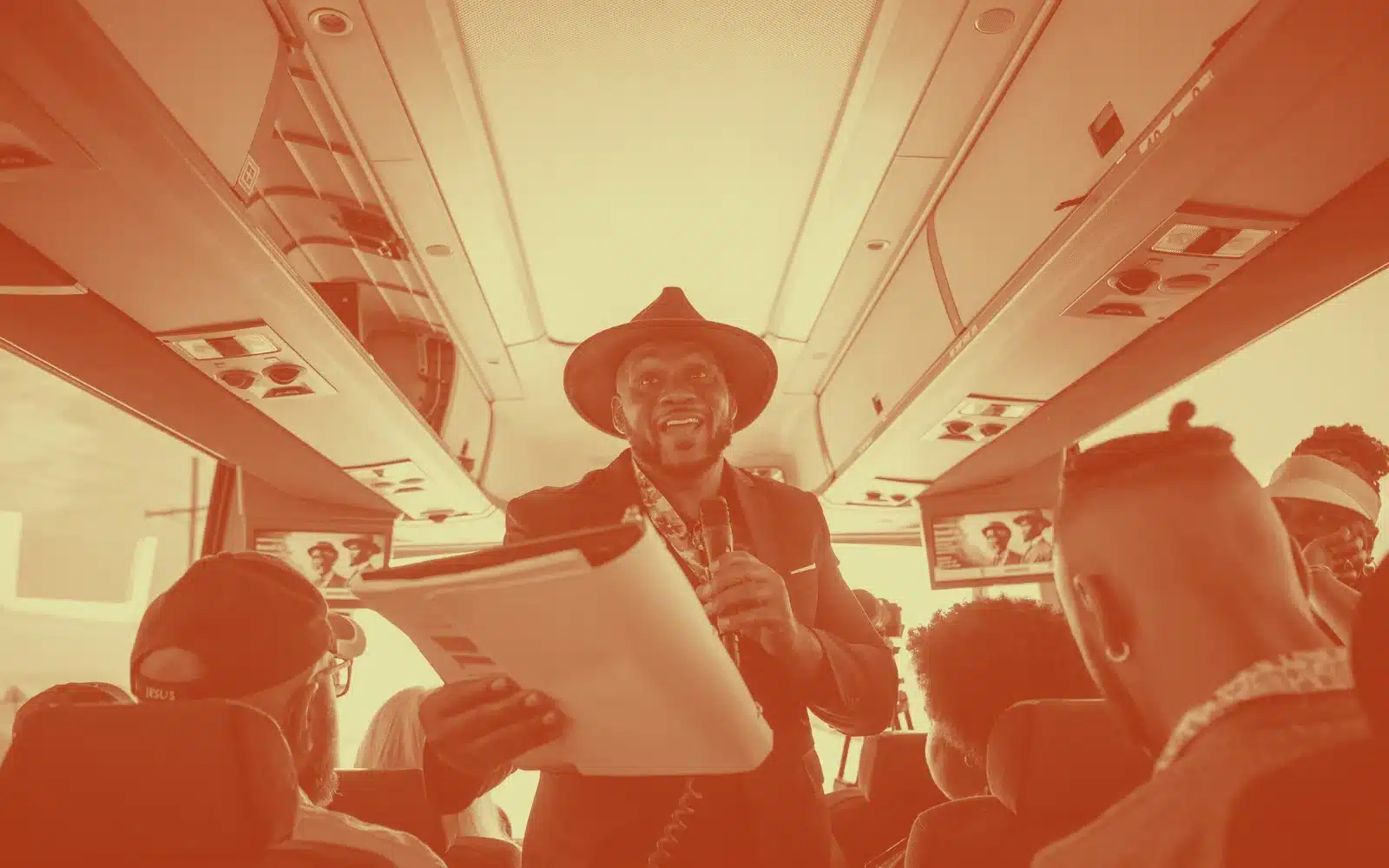
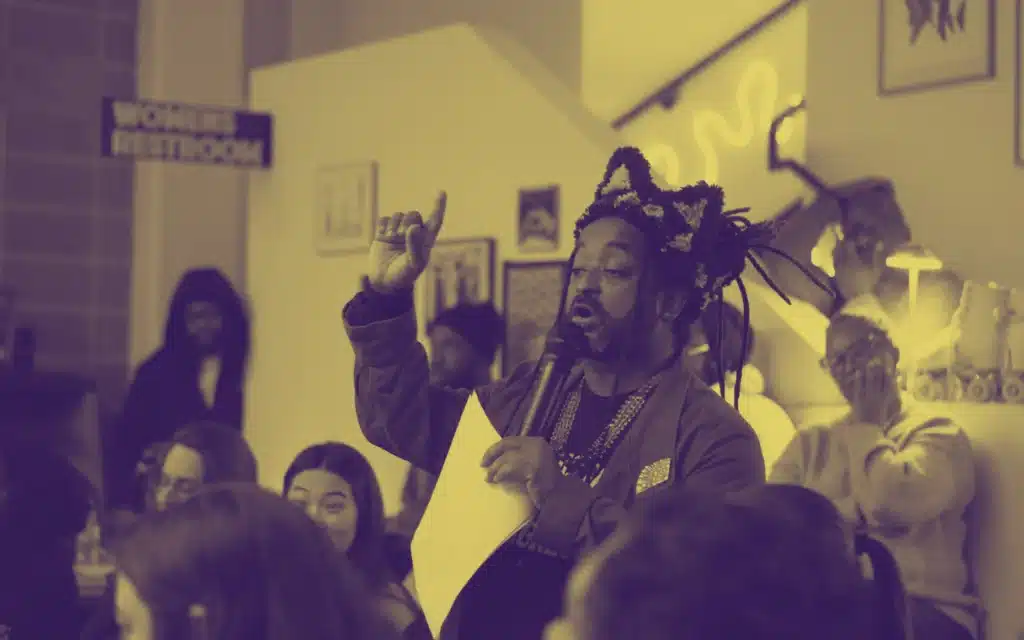
Cultural Heritage Ambassador & local farmer Dorfus Youngs speaks about the history of Black farmers in the MS. Delta (Rory Doyle/The Walton Family Foundation, StoryWorks, and Delta State University)
In one of the Mississippi Delta’s oldest communities, a place renowned as the birthplace of American music, a unique form of cultural heritage preservation is taking root: a series of historic bus tours developed as the capstone project of the Delta Cultural Heritage Ambassadors Program. Held during the Sunflower River Blues and Gospel Festival, a three-day event that draws an international crowd, the tours offer a rich experience beyond the music, featuring locals sharing lived histories under cottonwood trees, actors performing at site-specific locations and explanations of why the county’s name, Coahoma, means Red Panther.
For nearly a decade, my colleagues and I at StoryWorks, a documentary theater company composed of artists, journalists and educators, have worked at the crossroads of investigative reporting and community-centered public art in Clarksdale, Mississippi. This work has placed us in the living rooms, churches, cotton fields, libraries and juke joints across the Delta listening to residents who hold entire histories in their memories and daily work.
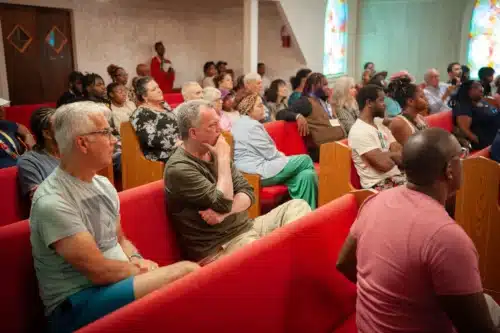
Tour attendees at St. James Missionary Baptist Church, learning about the role of Black Churches during Reconstruction (Rory Doyle/The Walton Family Foundation, StoryWorks, and Delta State University)
Over the years, we have heard a recurring refrain: while the Delta is rich with stories, only the Blues was receiving support and investment. Meanwhile, the communities that shaped that history were frequently excluded from benefiting financially from the burgeoning tourism industry built on their culture and labor. We found ourselves asking two simple but catalytic questions: If cultural experiences beyond the Blues were offered, would visitors be interested? And what could be done to help local residents build capacity to compete with the larger tourism industry?
We were confident that if we built this, people would come.
StoryWorks has been writing and performing documentary plays in the Mississippi Delta since 2017. Because of this longstanding presence, we were uniquely situated to help build a more authentic and holistic approach to local cultural tourism. In 2023, through a partnership with Delta State University and major support from the Walton Family Foundation, we created the Delta Cultural Heritage Ambassadors Program, an accredited cultural preservation and storytelling initiative open to residents of Coahoma County.
Two years later, we have graduated two unique cohorts totaling twenty-one participants, ranging in age from 19 to 71. Their backgrounds speak to the depth and variety of cultural expertise within the community: librarians, pastors, quilting artists, a fashion designer, a juke joint owner, a baker, community organizers, farmers and a journalist, only to name a few. Their shared qualifications were not formal degrees or resumes but deep community stewardship and a passion for history.
The curriculum was designed to provide practical training: research and oral history collection, historic preservation, journalism, narrative storytelling, performance, marketing, event planning and tour development. Weekly online classes, taught by the StoryWorks team with guest lecturers from the National Park Service, the Mississippi Department of Archives and History, Brown University and the University of Virginia, all built toward an intensive in-person summer program where participants co-created a large-scale exhibition that relied on their ability to research, design and curate a public experience.
Tour guests were treated to food, live performances, a quilting exhibition and narrative-rich stops that shared rare insights into the Delta’s layered history: Firsthand accounts of African American life during Reconstruction; the remarkable efforts of the Swan Lake Association in supporting newly enfranchised Black citizens; the living traditions of the Mississippi Band of Choctaw Indians; the work of local civil rights leaders and the savory history of the Delta Hot Tamales.
The tours were vibrant, community-led explorations of Delta history. But behind the scenes, the program served a deeper purpose: it was a response to the state- and county-funded “Blues Tourism” that favors deep-pocketed developers while sidelining the very communities whose histories created the foundation for that industry. The Delta Cultural Heritage Ambassadors Program was designed to provide an antidote to this expropriation, asserting that cultural tourism should not only reflect authentic local narratives but also empower the people who live them.
Creativity and knowledge multiply exponentially when intergenerational partnership blossoms, creating a powerful collaboration. When a 71-year-old quilting artist discusses land memory with a 25-year-old journalist, or when a pastor and a farmer collaborate to map a hush harbor near a field of purple hull peas, the community begins to repair itself.
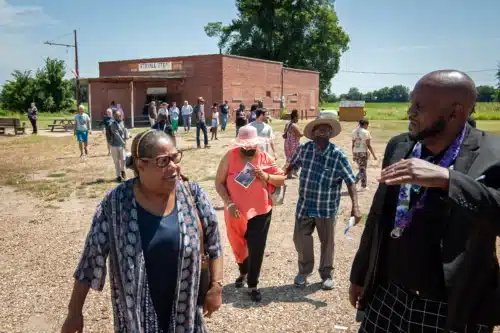
Tour stop at Stoval Plantation & Commissary, home of Muddy Waters (Rory Doyle/The Walton Family Foundation, StoryWorks, and Delta State University)
Through a Walton Family Foundation grant, the program covered all tuition for three undergraduate or graduate credit hours in Rural and Regional Studies at Delta State University and provided a stipend upon completion. Participants have used these funds to launch or strengthen their cultural heritage businesses and are creating new pathways for income, visibility and local pride.
The most unexpected outcome for StoryWorks has been one that local news outlets might strive for when doing similar work: we entered this program as a storytelling institution and now we are bridge builders. Scaling our engagement across the community has required patience and humility, showing up again and again, listening more than we speak and building trust one relationship at a time. These relationships have expanded our capacity to create documentary plays and inspired us to consider this work the future of civic theater. We have reshaped the norms we hold for community participation: we now expect deep collaboration and the community expects transparency, creativity and shared ownership from us in return.
We believe the Delta Cultural Heritage Ambassadors Program offers a replicable model for other communities facing similar challenges of cultural extraction — one that local newsrooms could use to cultivate community participation. When residents gain the tools to preserve and interpret their own histories, preservation becomes a form of resistance, protecting narratives that have long been overlooked or commodified. This creates a catalyst for economic resilience and civic connection.
We look forward to bringing what we have learned into more communities, guided by the principle that the most powerful stories are those shaped and shared by the people who live them.
Jenna Welch is the artistic director and creator of StoryWorks, a groundbreaking documentary theater project launched by The Center for Investigative Reporting in 2013 that transforms investigative journalism into theater. She has developed 12 new plays across the country.
Share with your network
4 ways to partner with community expertise and talent to strengthen local journalism
You also might be interested in:
We asked four summit participants to share more about the ways they are defining, measuring and acting on signals of impact.
Whether it’s an engaging personality breaking down complicated news on YouTube, a streamer testing their limits on an obstacle course or a short film series that meets people where they’re at, content consumption is fragmented — but also gives newsrooms an opportunity to create niche content that can succeed if paired with the right distribution strategy.
If you want to know how to reach teens and young adults, ask young journalists and the folks who work with them.


