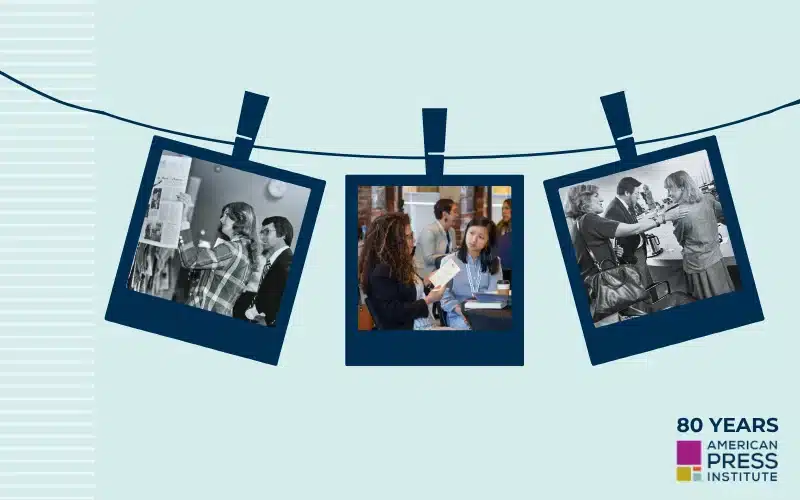
This year the American Press Institute is celebrating a milestone: 80 years of serving news leaders.
One thread runs through that history from 1946 to today: news leaders showing up for one another.
They came to API to learn, certainly. But they also came to share what they knew and make another leader’s path a little easier.
Whether at today’s API Local News Summits, through Table Stakes, Newspaper Next or decades of news and business seminars at API’s former home in Reston, Va., leaders have brought not only their questions but their experiences.
They have been willing to say, “Here’s what I’m learning. Here’s what I’m struggling with. Here’s what worked for us. And here’s something that might help you.”
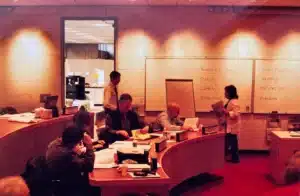
Local media participants review materials at API’s old building in Reston, Va. during a 2005 seminar.
In that sense, paying it forward has always been part of API.
Throughout our history, API has given busy news leaders distance from daily demands and the frameworks and structure to think critically about what comes next — plus people to think alongside. Today, as the solutions lab for local media, we hold that same space for leaders and support them with practical ideas, research, tools and resources that can help turn those plans into action.
Everything we do now builds on that long tradition.
So as you consider your experiences with API, we ask:
What has API made possible for you, and what might you help make possible for someone else?
If you’ve crossed paths with API — in a gathering decades ago in Reston, through a tool or piece of research, or in work we’re doing today — we’d love to hear what stayed with you.
As we mark 80 years, we’re also inviting individuals who have been part of API’s story to help make those experiences possible for others.
Here are three ways to participate:
- Share your story. We know the most valuable insights often live in people’s experiences and relationships. Tell us about an API gathering, idea, person or experience that shaped how you led or thought about your work. Sharing these stories matters. It helps us know what spirit and leadership insights to carry forward into our next chapter.
- Help another leader find their way to API. Share this article. Share a program or a Need to Know newsletter with someone who might benefit. Maybe you know an emerging leader in your own organization. Maybe your collaborator at the organization across town needs to know they’re not alone. They aren’t, and one of the simplest ways to pay it forward is to help someone find support and community they need.
- Donate to support the leaders who come next — and share a memory. A gift of any size helps us continue equipping local news leaders with ideas, research, relationships and practical support. As you give, we invite you to tell us what API made possible for you. (Photos, old catalogues and news clippings are welcome, too!)
This spirit goes back to the beginning. It was 26 newspaper editors who gathered at Columbia University for the first seminar in 1946. Newspaper editor Sevellon Brown had championed the idea. Funding for API’s first two years of operation came from 38 newspaper companies themselves.
Countless leaders have been empowered since, and much about our industry and world may look different now. But the core spirit is largely the same. We hope you’ll help us continue to build on it.
If the form below is not loading correctly, you can complete it here.
Share with your network
You also might be interested in:
Local news organizations have always had to navigate change: shifts in audience behavior and expectations, technology and product development, revenue and consumer value, and their [...]
We’ll dig into three areas that are important to the future of local journalism: civic trust, people and culture and organizational resilience.
Across all of our work, we’ve learned that the best solutions start with the people closest to the problem. We use evidence to inform what we do, create room to experiment and share what we learn so others can build on it.


