

I’ll never forget the conversation I had with an environmental funder in late 2024. She asked whether journalism actually moved anyone to do anything. I started to answer and realized I couldn’t. I had stats about our traffic. I had republication credits, including data center reporting that moved on the AP wire. I had institutional wins, including a city that corrected a decade of bad public information the day we published our reporting.
All of that shows how far the work traveled and how officials responded. But none of it describes what our readers did with the information.
I founded Planet Detroit, a nonprofit newsroom covering environment, climate and health in Southeast Michigan, in 2019. We now have seven staff and more than 480,000 unique readers in the first seven months of this year. Our beat is local climate issues, utility rate cases, industrial permits, rezonings and water infrastructure. Those decisions mostly get made in public proceedings that run on published schedules almost nobody follows.
Before journalism, I spent 15 years as a community planner in local government, so I knew what that funder was really asking. Our readers had a legal right to be in those rooms, but we had never once told them how to get there or why their presence mattered.
For five years, like most newsrooms, we measured impact retrospectively, and by luck. We tracked traffic, logged republication, and wrote down whatever visible thing happened after we published. Those outcomes are real, and we still count them. But they are often institutional. They describe what a government or a court did, and say nothing about the several hundred thousand people we publish for.
Our readers were persistent. They would reply to our newsletters, asking, what can I do about this? So in 2025, we started answering that question by hand. Our managing editor, Dustin Blitchok, and our reporters spent 45 to 60 minutes per article working out which body had jurisdiction, when it met next, whether a comment period was open, which community organizations were already on the issue, and how to link to all of that information. We put it in a box at the bottom of the story.
We weren’t sure if anybody noticed them, but we started seeing the evidence that readers used them. They submitted comments to the Michigan Public Service Commission and showed up at water authority board meetings. Several readers told us they hadn’t known they were allowed to participate at all.
But an hour per story is not survivable in a seven-person newsroom, so the boxes landed on the stories we had time for rather than all the ones that needed them.
Rebuilding the box as software fixed that, and did something I didn’t anticipate. To automate a box, we had to define a civic action in categories a database could hold: a meeting, a comment deadline, a decision-maker, an organization. Once those were structured objects on the page, they were countable.
Today, an editor pastes a story URL into a tool we call the Civic Action Builder. It analyzes the story against a civic infrastructure database we maintain: 35 scrapers tracking 95 government bodies across metro Detroit, plus 600-plus Michigan community organizations tagged by issue and geography. It drafts a plain-language sidebar listing the upcoming meetings, open comment deadlines, and responsible officials and organizations connected to that story.
An editor verifies every item and decides whether to publish it. Nothing goes live without a human signing off. Review takes under 15 minutes, down from the better part of an hour.
Two editorial principles govern a box. Every item should be as specific and verifiable as possible, so “submit written comment to docket U-21534 by May 28” rather than “get involved.” And every item has to be about participation rather than position. We show readers where a decision is being made and how to be heard there. We never tell them what to say.
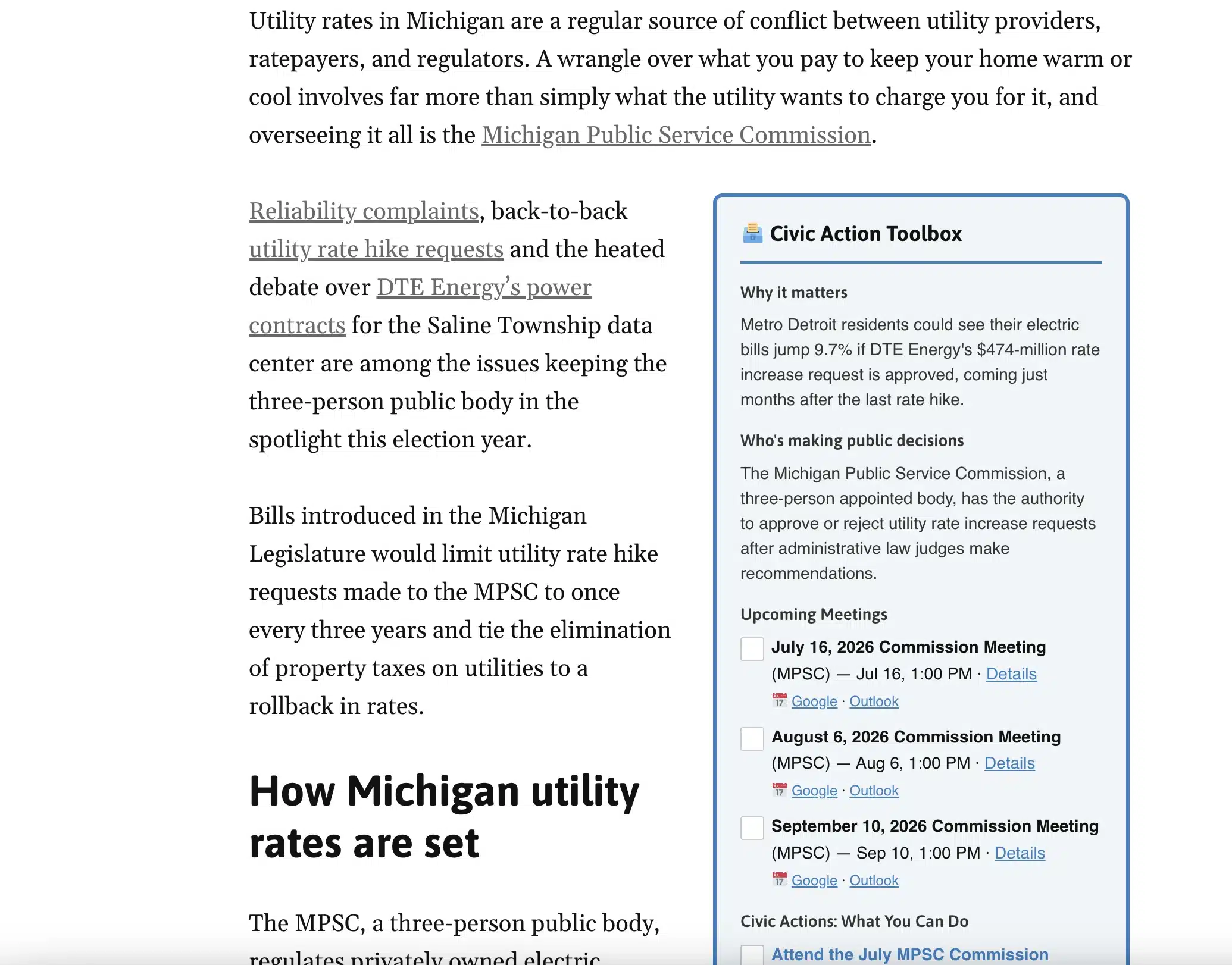
The Civic Action Box as it appears on a DTE rate-hike story, listing hearing dates, comment deadlines and the commissioners deciding the case.
Measurement is built into this workflow. Every action in a box has a checkbox readers can tick, and every check is an event recorded against that story. A form on the page lets readers tell us in their own words what they did. Because we know each story’s pageviews, we can express any of it as a rate.
So far this year, 75 stories have carried a box. They drew 146,617 pageviews, 903 checked civic actions, and 65 readers who wrote in to say what they did. That is 0.7% of readers taking a documented action.
Seven-tenths of a percent may not seem like much until you find a comparison. Nonprofit advocacy email draws a 1.4% response rate, per M+R’s 2026 benchmarks, from people who joined a list and opened a message asking them to click once. Our denominator includes everyone who loaded the page, including the reader who came off a search result and left in four seconds.
Just nine percent of Americans attend a local public meeting in a given year, per the Census Bureau and AmeriCorps’ Civic Engagement and Volunteering Supplement. Twenty of our readers told us they attended one after reading a story. Ten contacted an official.
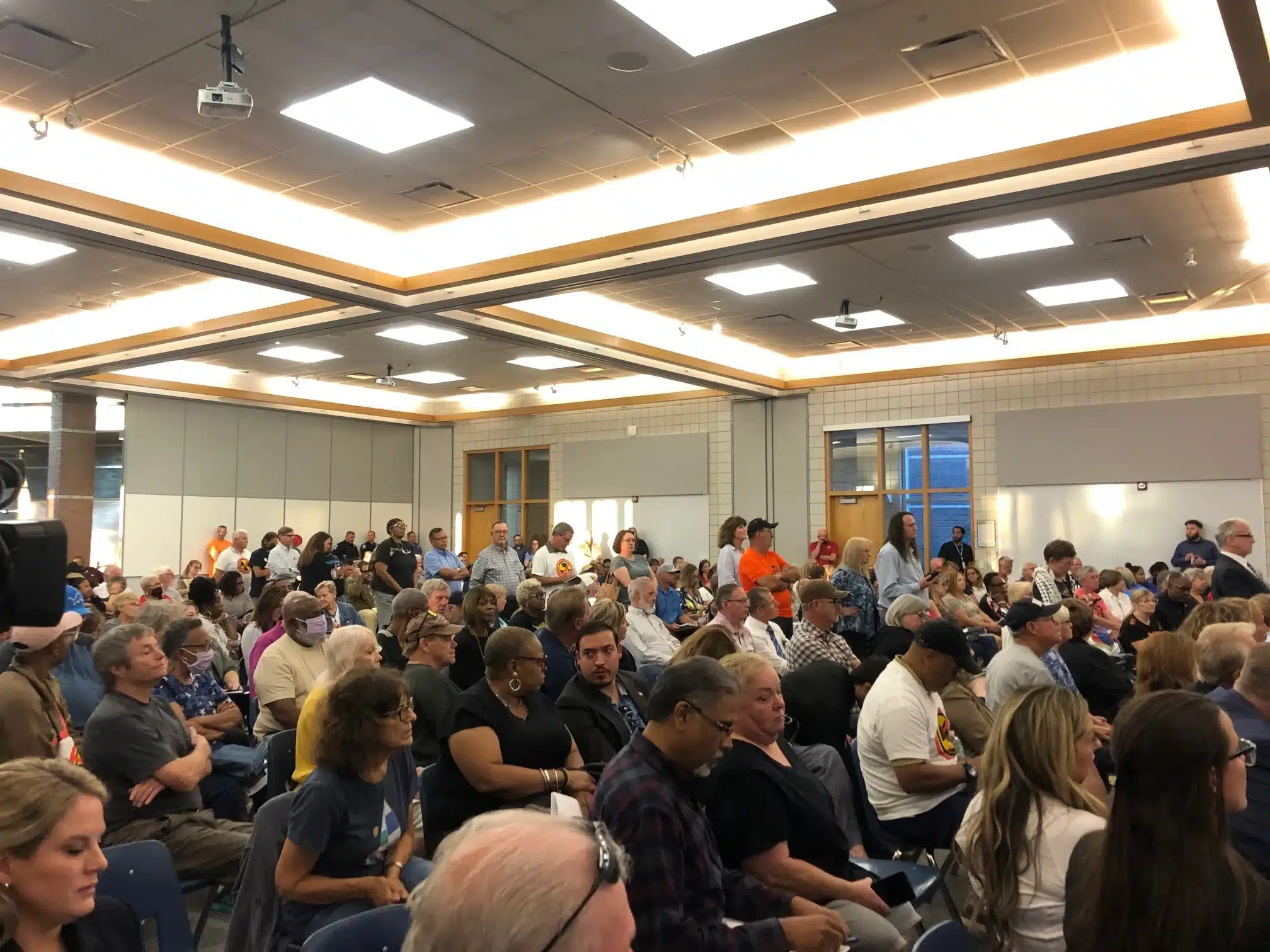
Hundreds turned out at a Belleville meeting to express anger about nuclear waste coming to Michigan. Photo by Brian Allnutt.
The distribution matters, too. Our eight most-read stories converted at 0.39%, while the 54 least-read pieces saw a 1.22% civic action engagement rate. Our highest civic action conversion rate all year, 5.7%, came from a story about a hearing on metro Detroit ozone standards that only got a few hundred visitors. It seems that the more precisely a story focuses on one pending decision, with one small actionable step, the more readers act on it.
We know that a checked box is not confirmed attendance, and everyone who writes in is self-selected. Our best data remains what the readers write in to tell us they did themselves. But this is evidence of readers moving toward participation, even if short of proof of what happened next. And it is also the first number of its kind we have been able to hand a funder who is looking for this kind of impact.
We call those who engage with us our civic actors, and our annual report now leads with them instead of pageviews.
If you are considering something like this, here are a few things I would tell you before you start.
- Do it by hand first. A year of manual boxes taught us what belongs in one and what readers ignore.
- Start where the calendar is public, and date every item. Rate cases, permits and zoning decisions run on published schedules with real deadlines. You do not have to invent an action, only surface one your reporter already knows. “Get involved” is not an action, but a docket number and a deadline is, and that specificity is your defense against the charge that you have started advocating.
- Draw the line at participation, not position. Tell readers how to reach the people deciding and never what to say to them. Having reporters write the boxes rather than a separate engagement team keeps that line clear, because the person writing knows what they can source.
- Compute a rate, not a total. Divide actions by pageviews for each story, and you get something comparable across your whole site, the way an open rate is. Totals tell you how big your traffic was. Rates tell you which journalism moved people. Our eight highest-traffic stories converted at a third the rate of our 54 smallest.
- Plan the loop before the data arrives. The cheapest impact data you will ever collect is a checkbox and an open text field at the bottom of the story, while the reader is still there. Deciding what to do with the answers is harder. Ours have started pointing at stories, including the reader who cannot find out where her own hearings are held.
Ashley Woods Branch, our chief revenue and partnerships officer, and I are 2026 Reynolds Journalism Institute Emerging Technology Fellows. The fellowship year is about making this work in other newsrooms. We are piloting in Michigan and other states and documenting how well it works and how it can be improved. To try it, sign up at https://civiclab.planetdetroit.org.
Nina Misuraca Ignaczak is founder and executive editor of Planet Detroit, a nonprofit newsroom covering environment, climate and health in Southeast Michigan. A former community planner, she is a 2026 Reynolds Journalism Institute Emerging Technology Fellow.