Local news organizations have always had to navigate change: shifts in audience behavior and expectations, technology and product development, revenue and consumer value, and their relationships with communities and even relationships within the newsroom.
 Some may be labeled business challenges, others editorial or technical, and still others cultural. But implementing the kind of change that begets true transformation ultimately depends on people. Can we see what’s changing? Can we develop new capabilities and capacities, while strategically stopping old ones, to respond better to change? Can we meaningfully influence what comes next?
Healthy, people-first organizations and teams know that a supportive culture is linked to enhanced capacity. These organizations don’t shield their people from the discomfort or uncertainty of change, nor do they suffer from a lack of movement. Instead, they create the conditions — and model the culture — that make change easier to understand and believe in, embrace and participate in.
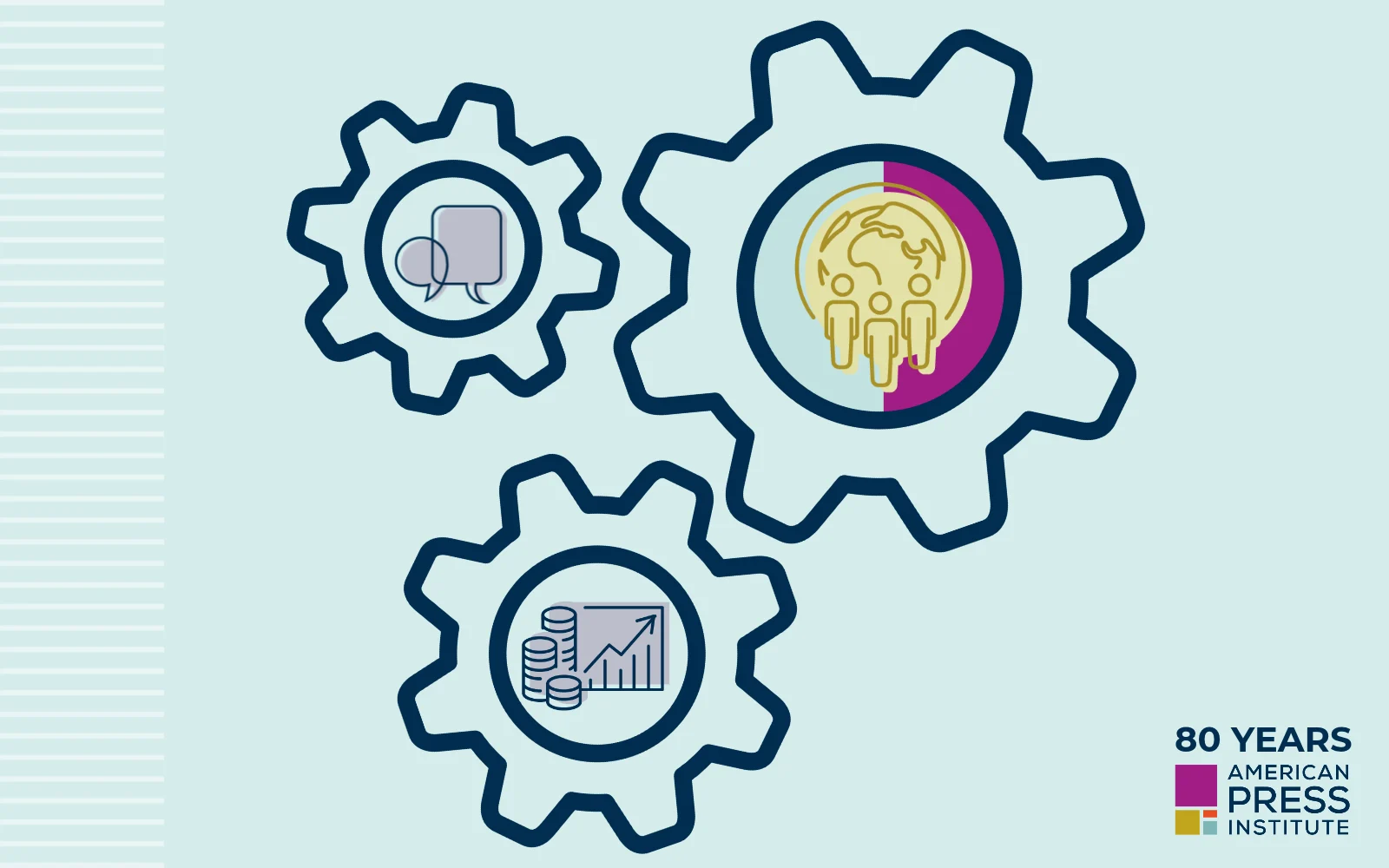
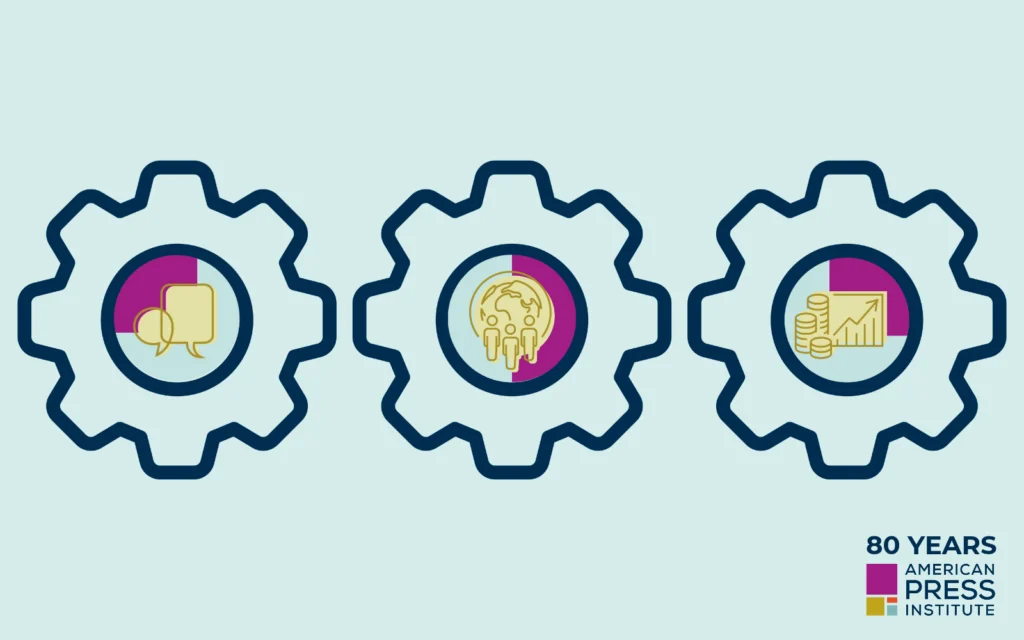
The American Press Institute helps news leaders build and protect those conditions through evidence, practical tools, cohort learning, leadership development and opportunities to experiment. Through our People & Culture work, we’ve learned three areas crucial to navigating change well: creating space and time to see challenges from a different perspective, building capacity and capability across the organization to help you solve problems in new ways, and sharing solutions and replicable strategies within your organization and with the wider industry.
See differently
It’s “from the balcony” — above the daily tasks and responsibilities — that news leaders can see challenges more clearly and differently. API creates space and time for leaders to explore emerging opportunities, identify bottlenecks and question assumptions. Such openness allows for more effective analysis of a challenge and execution of solutions to that challenge.
For example, The Houston Chronicle leveraged API’s Influencer Learning Cohort in 2025 to “think through what that might look like, what our early experimentation might be,” said Jennifer Chang, the Chronicle’s senior director of innovation and experimentation.
Leaders there had already noticed that creators were driving people toward its restaurant coverage — including new subscribers — but testing the assumption that local journalists can partner equitably with “influencers” felt like a risk best taken in community with other leaders asking the same questions.
The newsroom tested a partnership with Houston creator Shawn Singh while confronting real questions about ethics, control, workflow and impact. The experiment, partly supported by a $3,000 grant from API, produced audience and conversion results, but it also changed how the Chronicle thought about its own journalism.
API’s creator work was explicitly designed to help news organizations experiment with what co-creating community-engaged journalism could look like — something many traditional newsrooms find uncomfortable. From 2024 to 2025, API supported 16 organizations (three twice) in testing trusted messenger partnerships, and the learnings then informed API’s 12-part Guide to Influencer Collaborations.
Build capacity
API has found that news leaders are often quite clear on what they want to do differently — host more events, build new products, collaborate across teams, engage audiences in new ways. The harder question is: Does the organization have the people, processes and shared knowledge to do the work repeatedly?
Boise State Public Radio was a Table Stakes Live Event Sprint participant in 2024, where a culture of intentional collaboration directly influenced their ability to:
- gain new capabilities,
- establish cross-departmental responsibilities,
- build processes and
- turn an experiment into a repeatable organizational strategy.
The sprint demonstrated that capacity doesn’t increase just by having more time. To increase it, you need shared know-how, clear infrastructure and confidence earned through practice.
Building capacity isn’t about insulating people from change. It’s about equipping them to navigate it with shared knowledge, clear processes and opportunities to practice new ways of working.
Turn learning into shared practice
The most useful learning doesn’t stay with the person who attended the training, summit or cohort. It travels when news leaders then build it into their organization’s routines — who participates in or influences decisions, how feedback changes the work, what skills people practice, even what gets repeated.
For example, after API’s Youth Trust and Civic Resilience Summit, Stet News began inviting student journalists into editorial meetings and creating more regular feedback loops around reporting and coverage. A follow-on experiment helped those same students turn civic reporting into video, giving the Stet newsroom a storytelling capability it didn’t previously have.
Learning can become shared practice when we are intentional about it, just as Stet News did when they moved youth decisions and feedback into editorial and organizational processes.
And the same idea applies to internal culture. Knox News used an API learning cohort and grant to build learning into its everyday practices. Reporters created Beat 101 guides, all-staff meetings incorporated more learning opportunities, onboarding changed, and staff gained more chances to lead projects and share expertise.
Because learning is more than professional development. It matters when it changes our routines and decisions, our roles or the systems we work within.
This is where API’s role is distinct. Across local news summits, cohorts, coaching, sprints and experiment funds, private training and facilitation, API creates opportunities for leaders to test ideas in practice, compare what they are learning and make that learning explicit. API listens for patterns, helps surface what worked and where folks got stuck, and puts those lessons back into field circulation where one newsroom’s experiment can solve another newsroom’s problem.
API also rolls these opportunities and research back into its own feedback loop, where lessons can inform a next cohort, a Better News case study, a guide or a webinar. API actively translates our work because knowledge is most useful when people encounter it again, in a form that fits the decision they are trying to make at that moment.
Looking ahead
While local journalism is well positioned to identify and address community needs and information gaps, capacity often stalls these opportunities. Whether you’re a small, rural public radio station, a mid-sized start-up, or even part of a large local newspaper chain, finding space to experiment is difficult. Amid a 24-hour news cycle and splintered audiences with diverging news habits, news leaders find it harder to serve their communities through capacity-building initiatives and innovations that meet core community needs while enabling the organizational growth required to keep the news coming.
The pressures facing local news leaders will keep changing — from AI and audience fragmentation to new competitors, revenue models and expectations from communities. API cannot predict every challenge local news organizations will face, but it can create permission to learn and question in psychologically safe, interdisciplinary environments, while helping leaders build the muscle to meet these challenges with the perspective, capabilities and influence needed to respond effectively.
As we look ahead, API will use its convening power to super-serve the local news field. Expect our local news summits to become solution labs to challenges that have been around just long enough for news leaders to be actively testing and sustaining strategies to navigate the challenges. We are committed to guiding leadership in an AI-driven and information-rich environment. We’ll partner with innovative news leaders whose curiosity, willingness to experiment, and openness to learning are vital to our shared mission.
For 80 years, API has evolved alongside the people and organizations shaping journalism. As the challenges change, our role continues to evolve as we work to help news leaders see what’s coming, build the capacity to respond and turn what they learn into practice.
Explore, or consider supporting, API’s practical tools, training and learning opportunities designed to help local news leaders navigate change — from organizational culture and leadership to experimentation, engagement and resilience.
Sam Ragland is the senior vice president of the American Press Institute. She joined API in 2022. She can be reached at sam.ragland@pressinstitute.org.
Share with your network
You also might be interested in:
We’ll dig into three areas that are important to the future of local journalism: civic trust, people and culture and organizational resilience.
Share how the American Press Institute helped change how you lead, think or serve your community — and pay it forward to those shaping local news next.
Across all of our work, we’ve learned that the best solutions start with the people closest to the problem. We use evidence to inform what we do, create room to experiment and share what we learn so others can build on it.


