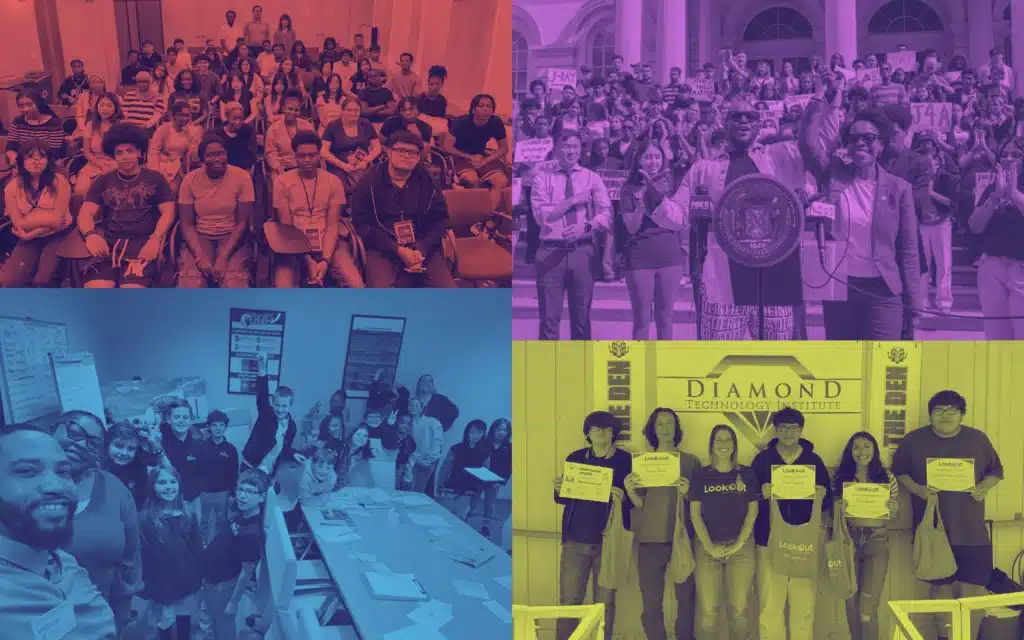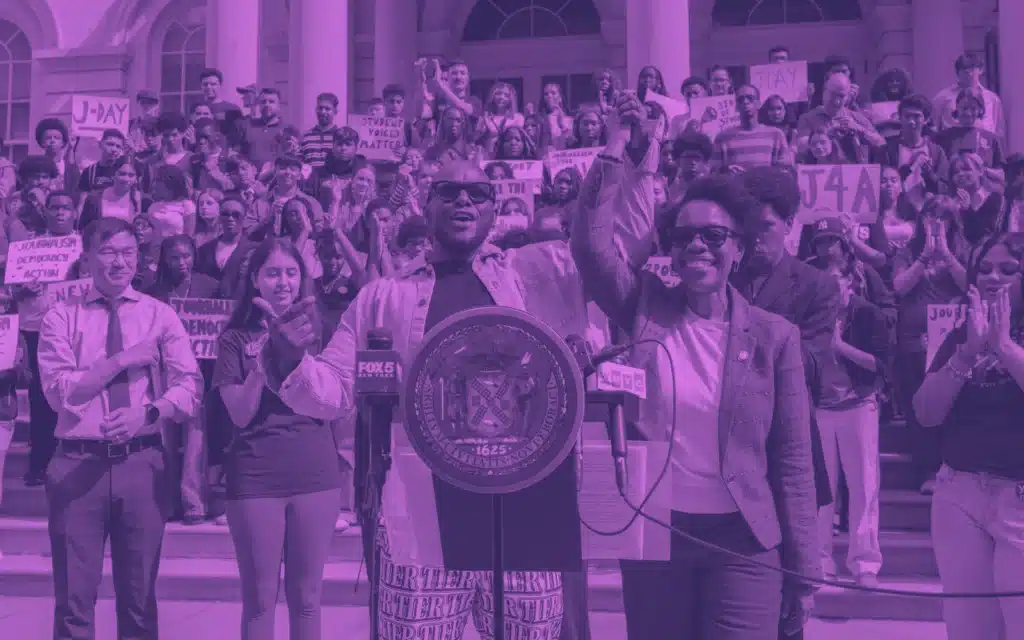
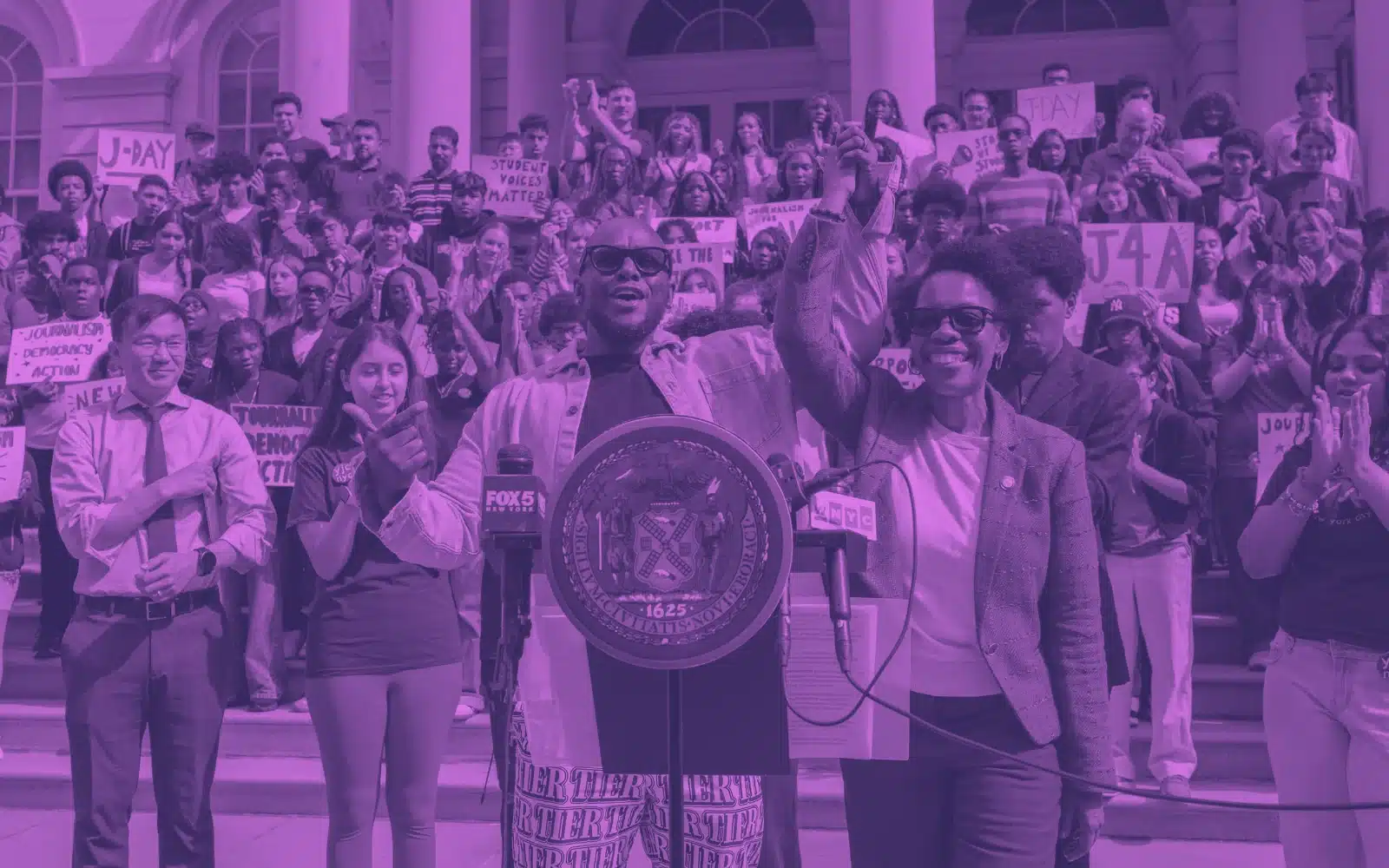
New York City high school students gather at City Hall on Sept. 16, 2025, to advocate for expanding school journalism programs. (Photo by Dulce Marquez)
Ask a room full of journalists where they got their start, and many point to the same place: a high school classroom, an inspiring adviser, a first byline in a student newspaper.
This was my story. I used my high school newspaper clips to land an internship at my hometown paper; those clips, in turn, paved the way to a national newsroom internship. It is a well-trodden path, but it requires that the first rung of the ladder actually exists. Today, for too many students that first rung has been removed.
Across the country, journalism programs have disappeared from public schools, particularly in low-income communities. In New York City, the media capital of the world, a mere 1% of public high school students took a journalism class last school year. Nationally, the data is sparse, but the trend is clear: journalism has become a luxury in public schools, not an expectation. Visit a National Scholastic Press Association conference and you will see a sea of mostly white students from affluent districts. When that’s who predominates the ranks of student journalism, it makes sense that the professional news industry remains overwhelmingly white.
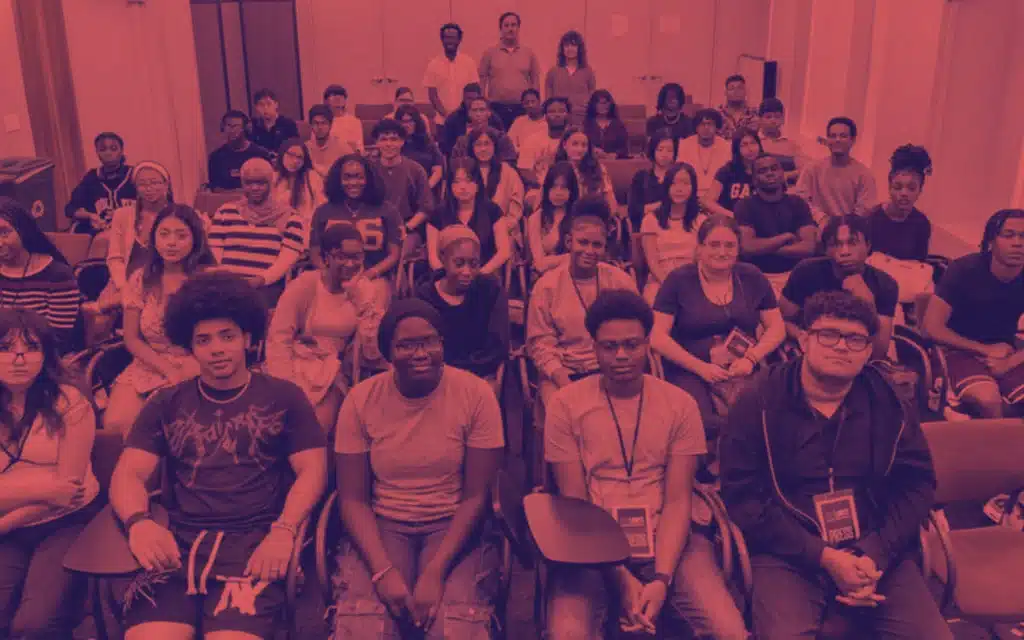
At The Bell, we work to bridge this gap by expanding journalism opportunities to students from underrepresented groups. Since 2018, we’ve trained more than 150 New York City students in paid audio reporting internships, publishing their coverage of local education on our nationally recognized podcasts. Yet, for every student we accept, we are forced to turn away a dozen others, sending them back to schools without a journalism class. As long as school programs remain scarce, demand for out-of-school programs like ours will almost certainly outpace supply.

High school students gather at City Hall to advocate for expanding school journalism programs. (Photo by Dulce Marquez)
Journalism is not like other extracurriculars. Lack of access to youth baseball presents a problem for the sport of baseball. Lack of access to youth journalism presents a fundamental threat to our news industry and our democracy. This is both a question of who will do tomorrow’s news reporting and who will value it. Students who never encounter journalism in school are less likely to see news as relevant, trustworthy or worth supporting as adults.
Connecting the ecosystem
A few years ago, we decided to address this challenge head-on — not by expanding The Bell’s own programs but by taking a collective action approach. With seed funding from the Charles H. Revson Foundation, we convened higher education partners, newsrooms, scholastic journalism experts, school officials and youth media nonprofits to form the NYC Youth Journalism Coalition.
After a year of planning, YJC developed “Journalism for All,” a public-private initiative to help high schools citywide launch new credit-bearing journalism courses. The goal was to create durable infrastructure that could outlast any one organization or philanthropic grant.
Journalism for All has five main components:
- High-quality, open-source curriculum developed at the Craig Newmark Graduate School of Journalism at CUNY
- Specialized teacher training led by the CUNY Newmark team
- Startup equipment and resources for schools, including monetary grants
- Tailored technical assistance and coaching from experts in student news production
- Paid student internships in partner newsrooms across the city
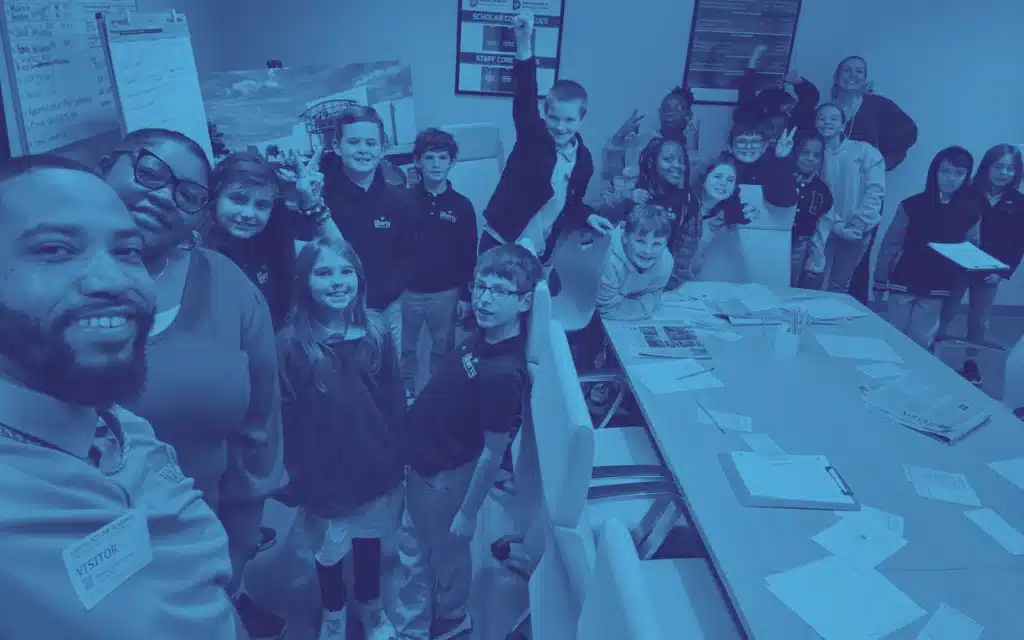
When new journalism courses launched at 30 Journalism for All pilot schools in September, they collectively reached more than 800 students, introducing them to reporting basics, journalistic ethics and multimedia news production.
This initiative is already inspiring tangible policy shifts, driven largely by the students themselves. YJC student leaders led the charge on building support within the New York City Council, securing the passage of a local law that mandates annual data collection on student journalism availability. Their advocacy has also unlocked discretionary funding from several Council members for Journalism for All schools in their districts.
Now, we’re gearing up for our first round of paid summer internships. By partnering with the city-funded Summer Youth Employment Program, we’ve connected 40 Journalism for All students to paid internships at 11 newsrooms, including New York Amsterdam News, Documented, Vamos Forward and Capital B. For six weeks this summer, these students will report stories, experiment with youth-centered audience engagement strategies and bring perspectives that are often missing from local newsrooms. In the fall, they’ll take the lessons they learn from their internships back to their upstart school newsrooms.
The work is ambitious, and sustaining it will require long-term investment and coordination. Launching journalism programs inside public schools means navigating teacher turnover, shifting administrative priorities and perennial funding challenges. But these barriers are precisely why collective action is necessary. No single newsroom, nonprofit or school can solve this problem alone.
To power the initiative, several other foundations followed Revson’s lead, contributing more than a combined $1 million. By providing the early investment needed to build the Journalism for All infrastructure, these foundations are ensuring the long-term health of local journalism.
Understandably, much of the current philanthropic investment in journalism focuses on bolstering struggling outlets and seeding new ones (the top rungs of the ladder). But equal investment is needed at the first rung. Without a sturdy foundation, today’s newsroom ventures will lack a pipeline to sustain them.
The role newsrooms must play

Mher Melikyan practices his audio interviewing skills as part of The Bell’s audio journalism internship. (Photo by Carolina Hidalgo)
While funders, nonprofits and schools can provide a structural backbone, newsrooms of all sizes have an essential role to play in expanding early journalism access. One natural place to start is documenting the problem. In New York, news coverage of the journalism gap in local schools helped transform a quiet crisis into a public mandate, galvanizing the support we needed for citywide action.
Newsrooms have a clear self-interest in solving the problem. Today’s students are tomorrow’s reporters, subscribers and news consumers. Here are three things newsrooms can do right away to strengthen their ties to young people in their communities:
1. Give your news to schools for free. Remove any barriers to your content. The Atlantic made headlines last fall for giving U.S. public high schools free access to all of its content. Local outlets across the country should do this, too. The Clinton Courier, a small-town paper in Mississippi, sends home free editions in every elementary school student’s backpack.
2. Open your pages and airwaves to students. It is time to dispense with the gatekeeping that has historically kept youth voices on the sidelines. Engage with students not just as subjects of your reporting, but as collaborators. The Minnesota Star-Tribune publishes work from ThreeSixty Journalism’s high school reporters. KALW trains local teens in audio storytelling and then airs their stories. Chalkbeat New York partners with The Bell’s students on a local education podcast and regularly features stories from high school news outlets in its daily newsletter.
3. Optimize content for educators, not just algorithms. Teachers are hunting for ways to bring relevant current events into their classrooms. Make it easy for them. Lookout Santa Cruz sends teachers across the county a weekly newsletter with classroom-ready stories, quizzes and lesson plans. The newsroom acts as a partner in civic education, ensuring that students see local journalism as an essential part of their lives.
Partnering with local schools builds students’ civic knowledge, news literacy and trust in journalism. It shows them that the news sees and cares about them. Newsrooms benefit, too. When it comes to long-term audience development, investing in relationships with schools provides a much better return than a viral social media video.
Scaling beyond the “media capital”
There is no one-size-fits-all solution to the erosion of early journalism access. The Journalism for All model is a multi-layered solution to systemic inequities in the nation’s largest school system. While the scale is unique to New York, the principles are portable. The Journalism for All curriculum, available for free at teachjournalismforall.com, has already been accessed by more than 500 educators in 45 states.
Last year, The Bell opened its second office in Jackson, Miss. In partnership with Press Forward Mississippi and the Mississippi Scholastic Press Association, we recently launched a statewide effort to expand high school journalism programs. Starting this fall, 18 high schools, including all six Jackson public high schools, will launch new courses using the Journalism for All curriculum. By leading successful initiatives both in the nation’s media capital and in the Deep South, we are demonstrating that the school journalism gap is neither inevitable nor insurmountable.
We must reach young people where they are — not just on their screens, but in their classrooms, Monday through Friday, between 8 a.m. and 3 p.m. If we believe ourselves when we say that journalism is a foundational part of our democracy, we must start in the places where young people are first finding their voices — where so many of us found ours.
We cannot expect the next generation to defend a free press if they are never given the tools to join it.
Taylor McGraw is the executive director and co-founder of The Bell, a nonprofit that’s building the next generation of journalists and civic leaders. He got his start in journalism working on his high school newspaper in Oxford, Miss.