
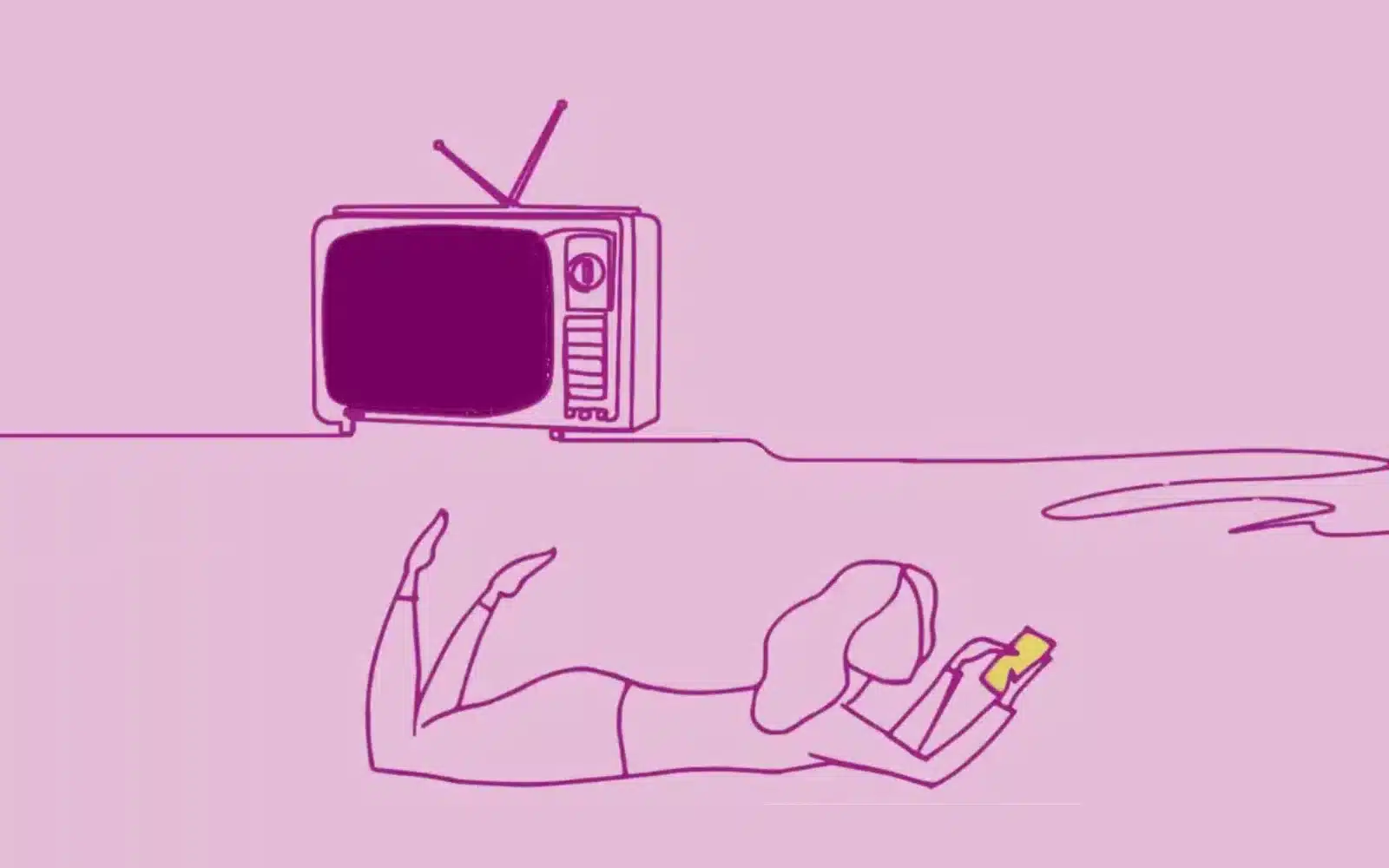
Mabruk Alam, a high school student at the Dreyfoos School of the Arts in West Palm Beach, Fla., said when he unlocks his phone screen, he’s often flooded with personality-driven clips –– quick excerpts of longer videos.
As he scrolls through the social media feed, he might encounter a 40-second breakdown of a global conflict sandwiched between a rising dance trend and a “get ready with me” video.
For Alam, news isn’t a destination; it’s an endless encounter –– a connection to a personable creator who could be anywhere in the world but feels like a neighborhood peer.
Now contrast this with how young people a few generations ago consumed news.
They may recall the thud of the less-diverse Sunday newspaper slapping the porch floor — a physical artifact of truth signaling a shared, generational reality in the comics and opinion sections. That ritual was aligned with the nightly newscast the family watched together, anchored by familiar figures — think Walter Cronkite, the “most trusted man in America” in his heyday — whose authority was rarely questioned.
Back then, the news was a collective ritual for mainstream audiences. Today, that shared symbolic hearth has been replaced by an endless stream of flickering screens, each tailored to Alam’s specific anxieties and identities. That fragmentation impacts news consumption habits, business models and how we communicate across generations.
Despite this dramatic shift, that emotional tether hasn’t completely disappeared, Alam argues. It has simply changed shape, moving from the institutional to the personal.
Alam, a second-year staffer and multimedia editor for his high school paper, The Muse, said attention spans are shifting toward instant, high‑energy content, where global livestream stars like iShowSpeed — known for chaotic, Jim Carrey–style IRL streams — and Kai Cenat, who, currently on hiatus, produces slap-stick comedy and celebrity‑driven events, increasingly rival traditional TV and movies and often blur the line between entertainment and news.
“I think especially now due to the nature of short-form content and algorithms, it takes a deep emotional connection for a relationship to be actually stable. These things are so fleeting because we are consistently pushed to move on,” Alam said.
“You see it in simple internet trends; for a week, it seems like the only thing on the internet, but by the next week, it is completely scrubbed,” he said. “It takes adaptability and universal application for a thing to stick, which makes Speed so successful.”
A recent Media Insight Project study compares how teens and adults consume and trust news. It finds young people increasingly rely on independent creators and influencers, while older adults still prefer traditional outlets like TV and newspapers. But across all age groups, transparency and factual accuracy remain paramount, and local news remains the most trusted source.
The influence of independent creators is most pronounced among teens 13-17 — 81%, according to the research, get news from influencers. And nearly 70% of teens and adults regularly use paid news products in some form, which debunks the myth that younger audiences only seek out free news products.
CONNECTING IN THE CLIP ECONOMY
iShowSpeed, an American who has more than 50 million YouTube subscribers, has been leading the streaming world with his adventures through countries in Africa and the Caribbean –– work increasingly viewed as a lifestyle or educational travelog that people are willing to pay for.
“His content can appeal to all age groups. It takes that ability to embrace change while staying tied to what makes you you,” Alam said.
No success today is without the new-age media distribution. iShowSpeed’s authentic relevancy is also fueled by what’s called the “clip economy,” trimming long-form audio and video — like streams, podcasts, interviews and TV — into short, attention-grabbing segments for distribution and monetization. Some clips can outperform full episodes in viewership and discovery.
Connecting emotionally in the age of feeds and streams also means collaborating directly with your local viewers.
Claudia Amaro, founder of Planeta Venus in Kansas, runs a hyperlocal, Spanish-speaking platform. “It’s a vital source for undocumented immigrants,” she said. Her distribution goals include creating content contracts and cross-posting videos on social media with her value-aligned news readers –– some “200 videos released two at a time each month,” she said. The content mostly appears on their Instagram account.
Whether it’s an engaging personality breaking down complicated news on YouTube, a streamer testing their limits on an obstacle course or a short film series that meets people where they’re at, content consumption is fragmented — but also gives newsrooms an opportunity to create niche content that can succeed if paired with the right distribution strategy.
THEN AND NOW: THE SHATTERED LIVING ROOM
There was a time when news consumption was a pillar of “intergenerational infrastructure,” Eunice Lin Nichols, co-CEO of CoGenerate, points out. She says we’ve lost the physical and social spaces where young and old once inevitably connected.
Now, there are echo chambers in the living room.
In the mid-20th century, the morning paper and the evening anchor provided a common language. Trust was built on a foundation of shared family consumption — you trusted the news because your parents did, according to a 2017 study. This research on adolescent news socialization shows “parental modeling” was a factor even across devices, such as mobile phones.
Today, that landscape is fragmented. It isn’t just a change in medium; it’s a change in the emotional DNA of news. And it has real-life civic and political implications, where younger and older people feel disconnected from each other, Nichols said.
For younger audiences, news has become a vehicle for identity and activism. Climate anxiety, social justice and the virality of a social media moment are the new benchmarks.
“Our research on what younger leaders want from older allies reinforces that young people value curiosity and authenticity — personal connection before collaboration. Always,” she said. “So, don’t just get out the vote, take time to hear each other’s stories. What did it feel like to vote for the first time? What issues do you care about the most and why? And perhaps most importantly: What’s a pain point you might share with someone significantly older or younger than you?”
In the context of news, age segregation fuels loneliness, ageism and generational blame at a time when younger and older people need to be solving problems, such as housing insecurity, together.
“National media loves eye-catching headlines about our country’s gerontocracy,” Nichols said, citing the barrage of “older people are hoarding potential” op-eds that flood her inbox.
This kind of coverage, she argues, intensifies generational divides. Instead of a shared emotional connection to the truth, we have a news cycle that fuels loneliness and blame.
When the news stops being a bridge and starts being a wedge, we lose the intergenerational infrastructure that makes collaboration feel possible, she said.
THE NEW EMOTIONAL LANDSCAPE
If the old news was a one-sided lecture, the new news is a conversation taking place in a third space. Young consumers are migrating toward the “informed friend,” said Emily Schario, founder of the Boston Globe’s B-Side, who says that newsrooms must transition from the “institutional voice of God” to something more human. “People like people,” Schario said. “They don’t necessarily have the same affinity or relationship they used to have with a media institution.”
Schario isn’t afraid to be “a little snarky” or have a hot take in the content she produces for B-Side.
“Having a real person front and center — especially one who’s allowed to lean into their unique personality — allows audiences to develop those meaningful relationships,” she said. “Think about why you’re friends with your friends: You align with their values, their perspectives, their tastes. When readers glimpse those things, it’s that much easier to make a connection.”
Schario once churned butter while running a seven-mile stretch of the Boston Marathon route to explain why the hills are so hard. It was silly, yes, but it was also a history lesson grounded in a real human experience. Schario took viewers through the Newton Hills, often considered the most difficult part of the course and known for its legendary performances throughout the marathon’s history.
“We bridge that gap by walking and talking like an influencer, but grounding our coverage in the same ethical and editorial standards as The Boston Globe newsroom,” she said.
Alam, the high school student, agrees that authenticity matters. He warns that when legacy media tries to reach young people without genuine desire, it comes across as corporate slop.
For Gen Z, the emotional attachment is built on the effort a platform puts into actually knowing them. “Real-life bonds and effort mean so much more than changing content to fit a young audience,” Alam said. “That more comes across as something organizations are required to do and not actually want to do.”
MEETING YOUTH WHERE THEY ARE
So, how are trusted messengers actually connecting with young people? It starts with an invitation. Caroline Klibanoff, executive director of Made By Us, which helps history museums serve as civic hubs for young people, believes that community intimacy begins at the “invitation level.”
“Don’t hold a symposium when you ought to have a bar crawl,” she said.
For Klibanoff, engaging young people means operating in their world, too — talk about midterm exams and simplify midterm elections.
Newsrooms are also experimenting with the archival impulse. Young people, who have lived through constant political and digital whiplash, crave something that lasts, and they want it all documented.
When Klibanoff’s team invited youth to contribute to a Smithsonian time capsule, the first thing they did was the math: How old will I be in 50 years? She said students often want their voice to outlive the immediate news cycle.
By asking young people to contribute to the historical record, newsrooms move them from the stress of a real-time post to the dignity of a permanent record.
“It is really a human impulse to be more than a fleeting part of history, to leave a mark,” she said.
“History, surprisingly, is a great tool to help you consider the future,” Klibanoff said. “By providing historical context, newsrooms can move readers from the stress of a current event to the hope of civic action.”
Nichols sees a similar path through solutions journalism. Instead of focusing on the zero-sum battles between generations, she highlights intergenerational housing innovations like Frolic Community or JoeyCo, which pair college students with older homeowners. These stories build a sense of belonging and trust, she said.
When people feel attached to their neighbors, they become loyal news consumers because they are invested in the outcome of their community.
SUSTAINABILITY AND THE FUTURE
In a world of “short-form content and algorithms,” as Alam puts it, only a deep emotional connection can keep a business relationship stable. But can that translate into a business model? Schario’s B-Side is proof that it does. By spending three years building a brand based on being an “informed friend,” B-Side was able to launch a $7-per-month membership tier. “Trust first, monetization second,” Schario said. People aren’t just paying for content; they’re paying for a mission they support and for real-world access, like supper clubs where members share a meal and conversation.
Authenticity as a loyalty driver: That’s one key to sustainable journalism.
Klibanoff reminds us that “engaged young people don’t stay young.” If they feel ownership over an institution now, they will become its donors and subscribers later.
The universal Sunday comics moment might not be a physical paper for most communities. It might be a notification from a trusted creator that feels like a text from a friend, or an intergenerational advice column in a local digital newsletter that builds sustainable bridges between generations.
As Alam notes, when people care about their craft, the audience can tell. That care is what makes people willing to pay, to stay and to participate.
Wilkine Brutus is a Murrow Award–winning multimedia journalist for WLRN, South Florida’s NPR and PBS member station. Brutus’ regional and national reporting covers the intersection of policy, emerging technology, arts and culture. He’s the founder of Maps & Diaries, an intergenerational documentary platform.
You might also be interested in:
We asked four summit participants to share more about the ways they are defining, measuring and acting on signals of impact.
If you want to know how to reach teens and young adults, ask young journalists and the folks who work with them.
We gathered news leaders and non-news experts to discuss what it looks like to build sustainable youth engagement efforts into their coverage and fundraising. We asked four summit participants to share more about the ways they are funding experiments with youth engagement in their communities.


