
Any discussion about how to reach and serve people using smartphones almost certainly must begin with social media. This was a major point of consensus among mobile leaders at our summit.
Using social media to connect with other people is the most popular purpose of smartphone app usage other than gaming. More popular than utilities or games or shopping, or news.
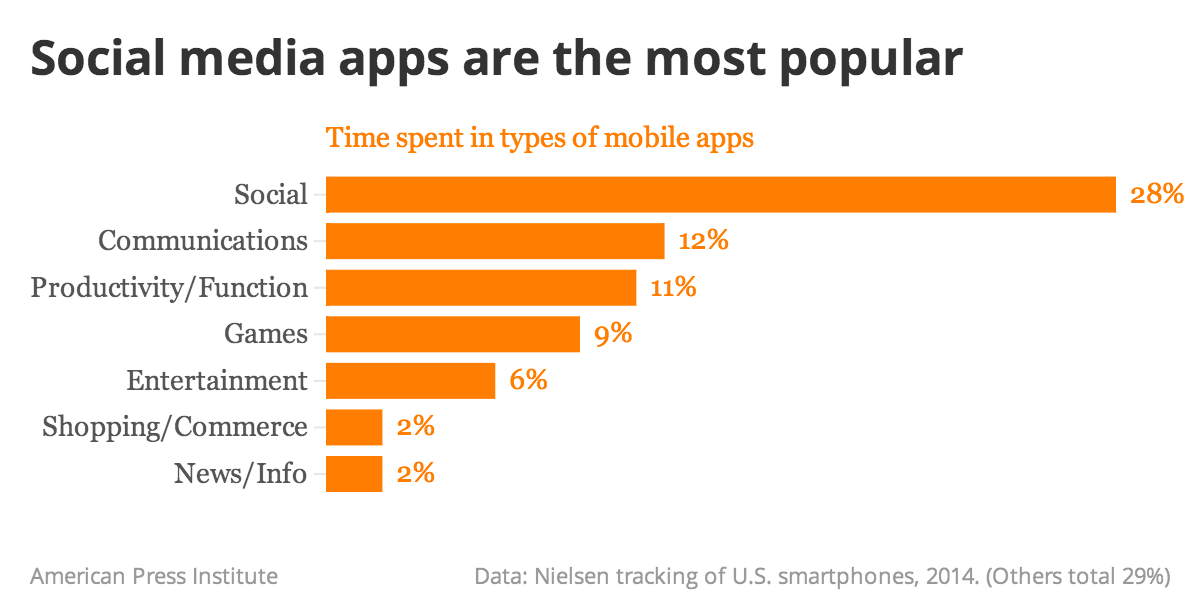
According to Nielsen data, U.S. smartphone users spend about 14 times more minutes using social media apps like Facebook than they do using news apps. Facebook mobile users spend more than 15 hours (914 minutes) a month on mobile usage.
It’s difficult to overstate the implications for news publishers.
BuzzFeed, which thinks of itself as a “social-first” organization, is now inherently “mobile-first” as well, because social is mobile, especially mobile Web.
As of early 2014, BuzzFeed gets most of its traffic from mobile devices, Vice President of Growth and Data Dao Nguyen told us. Its peak traffic hour has shifted to the evenings, around 9 p.m., rather than the typical daytime peak of desktop Web traffic.
BuzzFeed has to care a lot about its mobile experience. This means everyone in the newsroom has to think about it, not just the technology team. Its content management system now includes a “mobile preview” — before publishing a story the journalist sees how it would appear on a smartphone.
The results of the strategy have proven encouraging. The publisher’s mobile audience is sharing more, reading long-form content for longer periods, growing faster and clicking on native ads more often than its desktop users, Nguyen said.
Another example of twinned mobile-social strategy came from the Wall Street Journal, where the two fields were combined under the oversight of Emerging Media Editor Liz Heron.
Heron (who has since left the Journal for a job at Facebook) argued that mobile and social functions should be linked because the audience behavior, and audience itself, often overlaps. They are also the most disruptive aspects of newsgathering and production at the moment, and the areas with the most potential and need for innovation.
These mobile users who discover news via a social network app are in most cases landing on a publisher’s website rather than using a news app, a trend we discuss further in the next chapter.
Share with your network
Unlocking mobile revenue and audience

You also might be interested in:
There are three tactical ways local newsrooms can be the conveners for their communities: designing for human connection, designing for everyday usefulness and designing for joy, curiosity and surprise.
How do we bridge that gap between the standard KPIs and those mushier signals of your work’s impact — how can you identify and quantify what’s changing in the lives and perceptions of the communities you serve?
We asked four summit participants to share more about the ways they are defining, measuring and acting on signals of impact.


