American teens and adults, regardless of their age, use a variety of media, including traditional media, digital-only sources, and social media platforms to get news on a range of topics
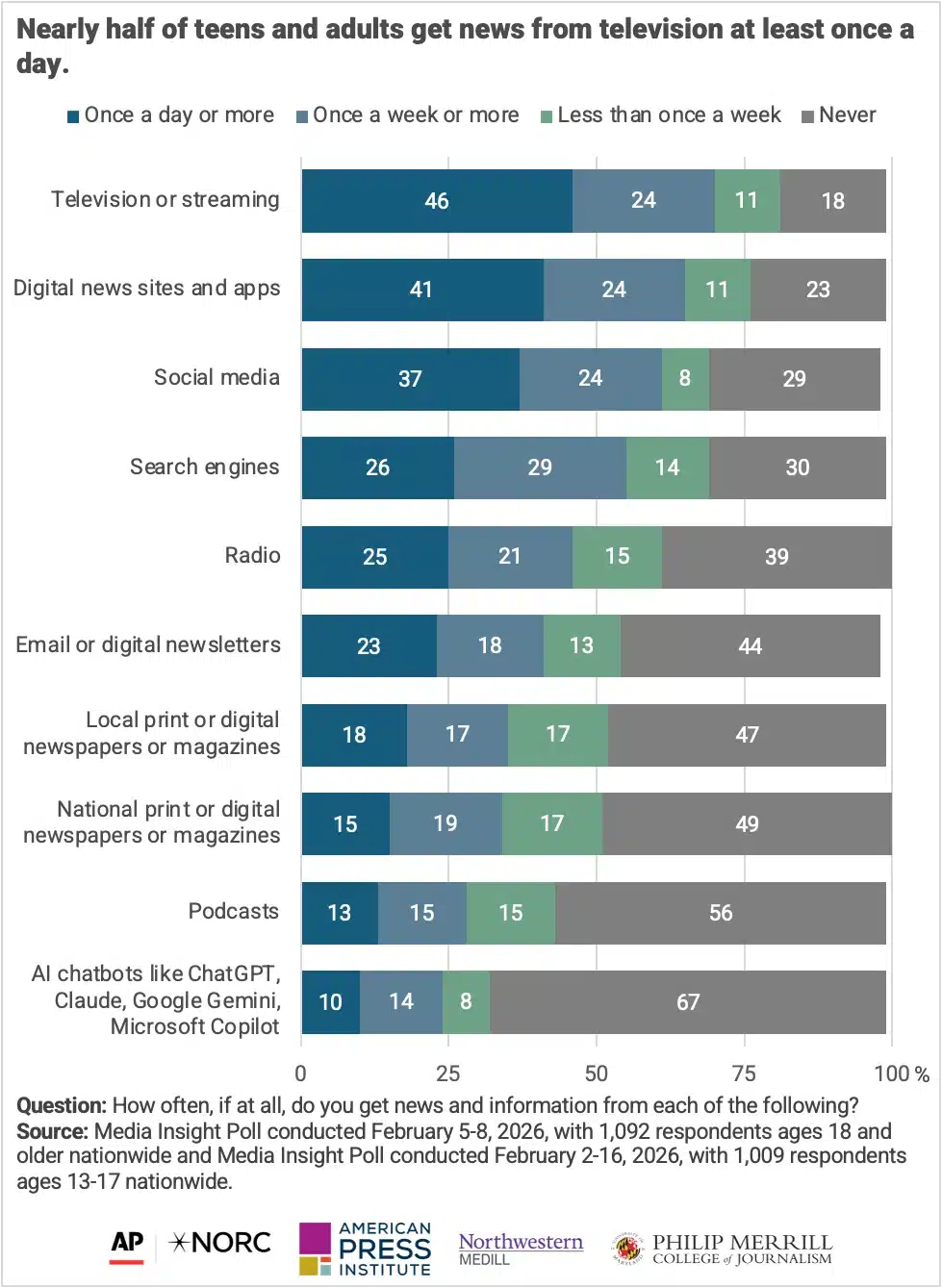
Many teens and adults get news at least once a day from television or streaming services (46%), digital news sites (41%), or social media (37%). About a quarter of the public gets news at similar rates from search engines or the radio. Print or digital newspapers are a less common news source for teens and adults, with about half never getting news from either of these sources. Podcasts or AI chatbots are even less common, with roughly half never using podcasts as a news source and two-thirds never using AI as a news source.
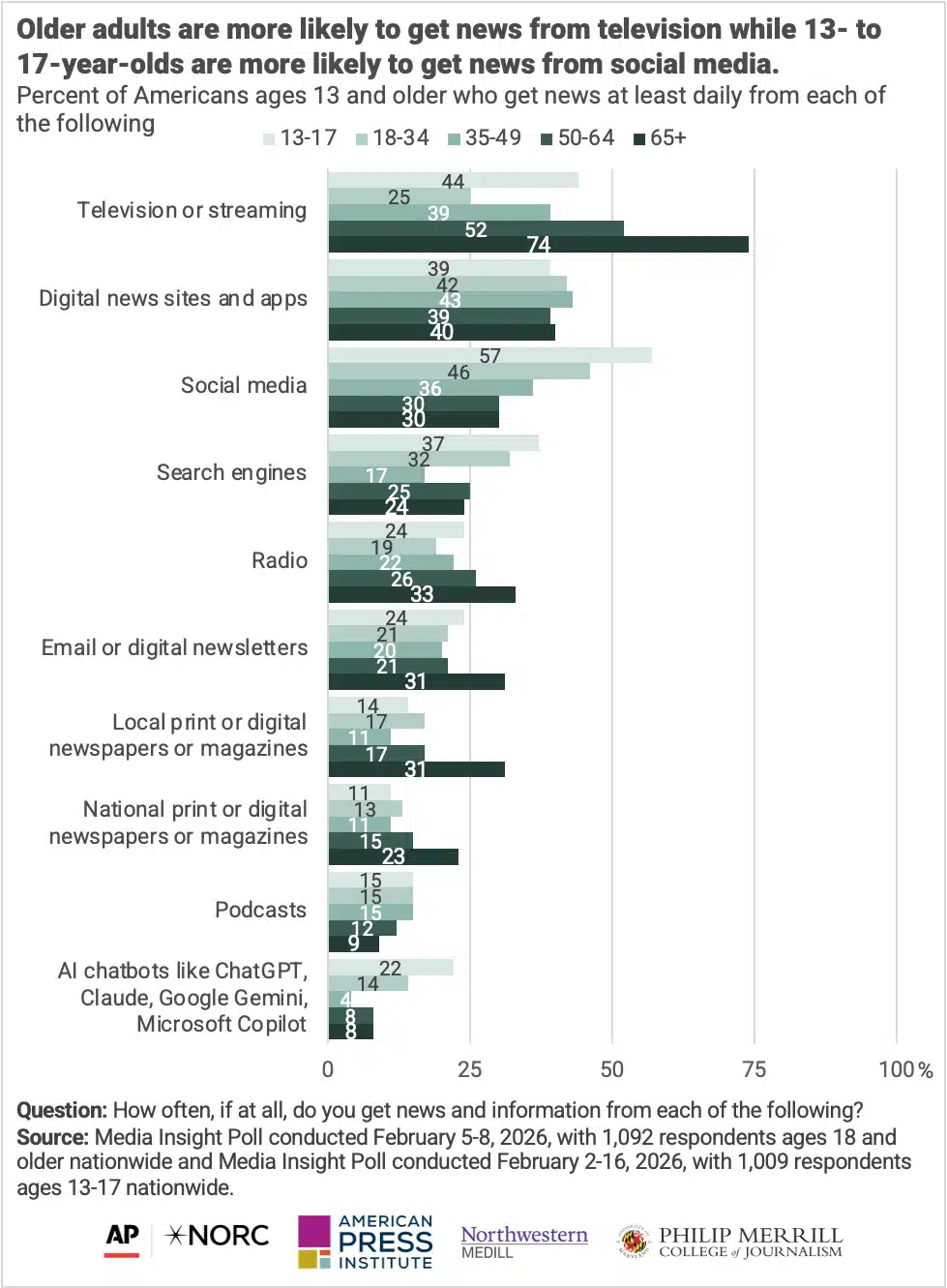
News consumption habits vary greatly by age. Americans ages 13-17 are more likely than any other age group to get news from social media, with over half (57%) relying on social media for news at least daily. Teens ages 13-17 are also more likely than adults 35 and older to use search engines at least daily for news (37% vs. 17% of 35- to 49-year-olds, 25% of 50- to 64-year-olds, and 24% of those 65 and older).
Adults who are 65 and older have different news consumption habits. A majority of adults age 65 and older get news from television or streaming at least daily (74%), more than any other age group. Adults age 65 and older are also more likely than younger adults or teens to get news at least daily from both local (31%) or national (23%) print or digital newspapers or magazines. Americans ages 13 and older get news at similar rates from sources like digital news sites, email or newsletters, or AI chatbots.
Among all adults ages 18 and older, some slight partisan differences emerge in their news consumption habits. Democrats are more likely than Republicans to use local (25% vs. 15%) or national (21% vs. 12%) print or digital newspapers, as well as digital news sites (50% vs. 39%) for news at least daily. Republicans are more likely than Democrats to use radio at least daily (31% vs. 17%).
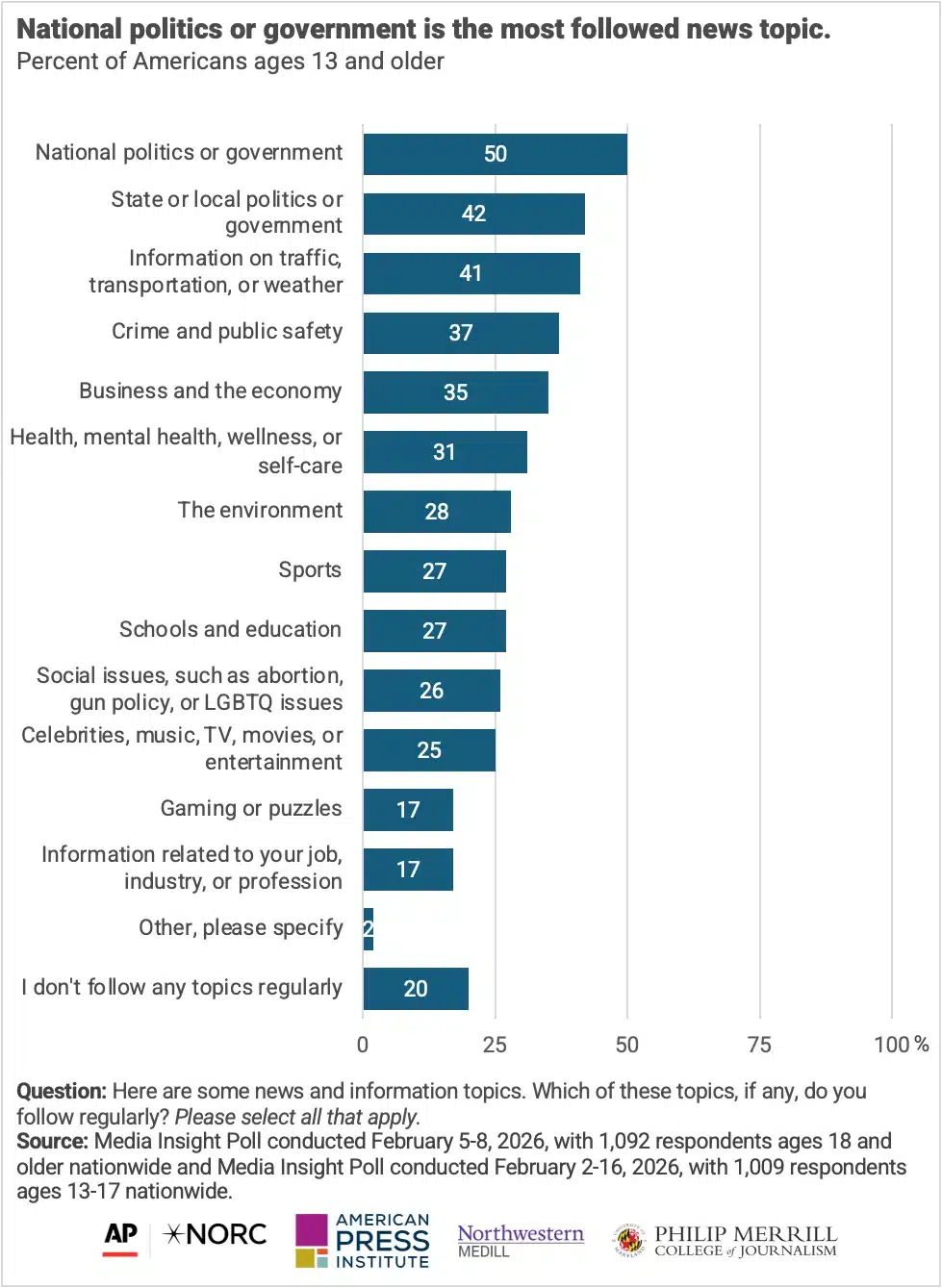
Teens and adults follow a variety of news and information topics. Out of the 14 news, information, and lifestyle topics asked about, teens and adults on average follow four topics regularly. Twenty percent of teenagers and adults don’t follow any topics at all. Some age groups are more tuned out than others, with middle-aged adults being the least likely to follow news topics regularly. Adults 18-34 (26%) and 35-49 (29%) are more likely than teens 13-17 (13%) or adults 65 and older (8%) to not follow any news topics. Adults 50-64 fall in the middle with 18% who don’t follow any topics regularly.
National politics and government is the most popular news topic, followed regularly by half of all Americans 13 and older. State and local politics, information about traffic and the weather, and crime and public safety are the next most common, with 4 in 10 Americans following these topics regularly. A third follows news about business or mental health or wellness.
Older adults are more likely to follow politics than younger adults. Adults ages 50-64 (60%) and adults ages 65 and older (65%) are more likely to follow national politics than younger adults or teens (41% of 35- to 49-year-olds, 40% of 18- to 34-year-olds, and 35% of 13- to 17-year-olds). For local politics, the pattern is similar, with adults ages 65 and older (60%) and adults ages 50-64 (49%) being more likely to follow national politics than all younger Americans (32% of 35- to 49-year-olds, 34% of 18- to 34-year-olds, and 23% of 13- to 17-year-olds).
Teenagers and young adults tend to follow fewer topics regularly than older adults. However, when it comes to news about sports, teens and adults ages 65 and older follow the topic at a similar rate (37% vs. 42%). Both groups are more likely than adults ages 18-34 (14%) or adults ages 35-49 (21%) to follow news about sports regularly.
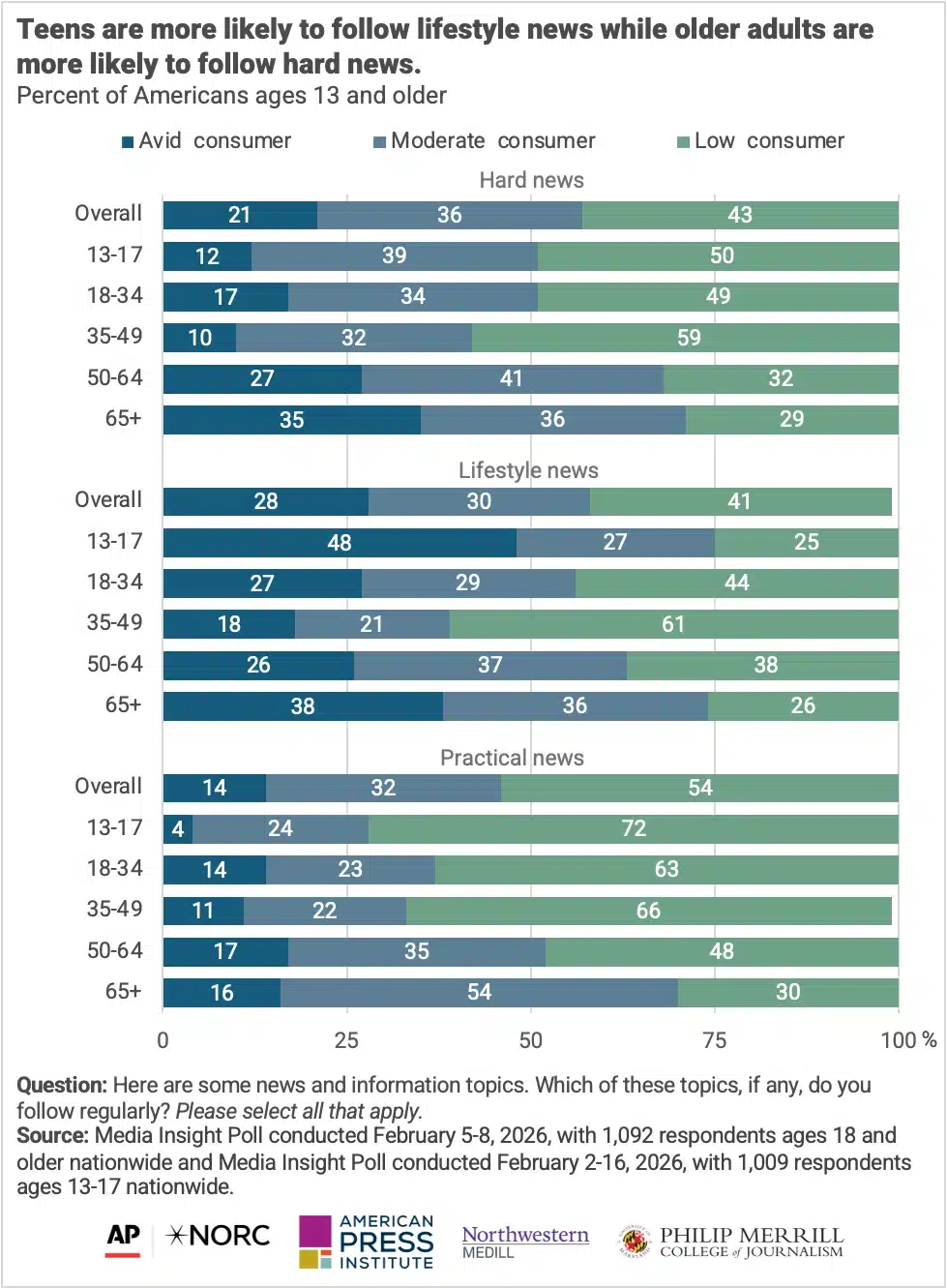
Respondents can be classified based on how many topics they follow by the three broad topic categories
To explore the news topics that interest American teenagers and adults, this study classifies them into avid, moderate, and low consumer groups for each of the three main types of news: hard news, lifestyle news, and practical news.
- Hard news topics include national politics, state or local politics, social issues, schools and education, business and the economy, the environment, or crime and safety.
- Lifestyle news topics include celebrity and entertainment news, sports, gaming, and health, wellness, or self-care.
- Practical news topics include information about traffic, transportation, weather, or information about their job or industry.
Teenagers and adults are sorted into each of these three consumer groups depending on whether they fall in the lowest, middle, or highest tercile of the total number of hard, lifestyle, and practical news topics they follow.
Avid consumers of hard news are more likely to be older, with 35% of adults ages 65 and older and 27% of adults ages 50-64 following hard news topics most frequently. Only 12% of teens are avid hard news consumers.
Unlike hard news topics, 48% of teens ages 13-17 are most likely of all age groups to be an avid lifestyle-news consumer. Adults 65 and older are the next most likely to follow lifestyle news a lot, with 38% being avid lifestyle-news consumers. A quarter of adults ages 18-34 and 50-64 are avid lifestyle news consumers.
All adults are avid practical news consumers at about similar rates. Teens are the least likely of any age group to be an avid practical news consumer with only 4% following this topic a lot.
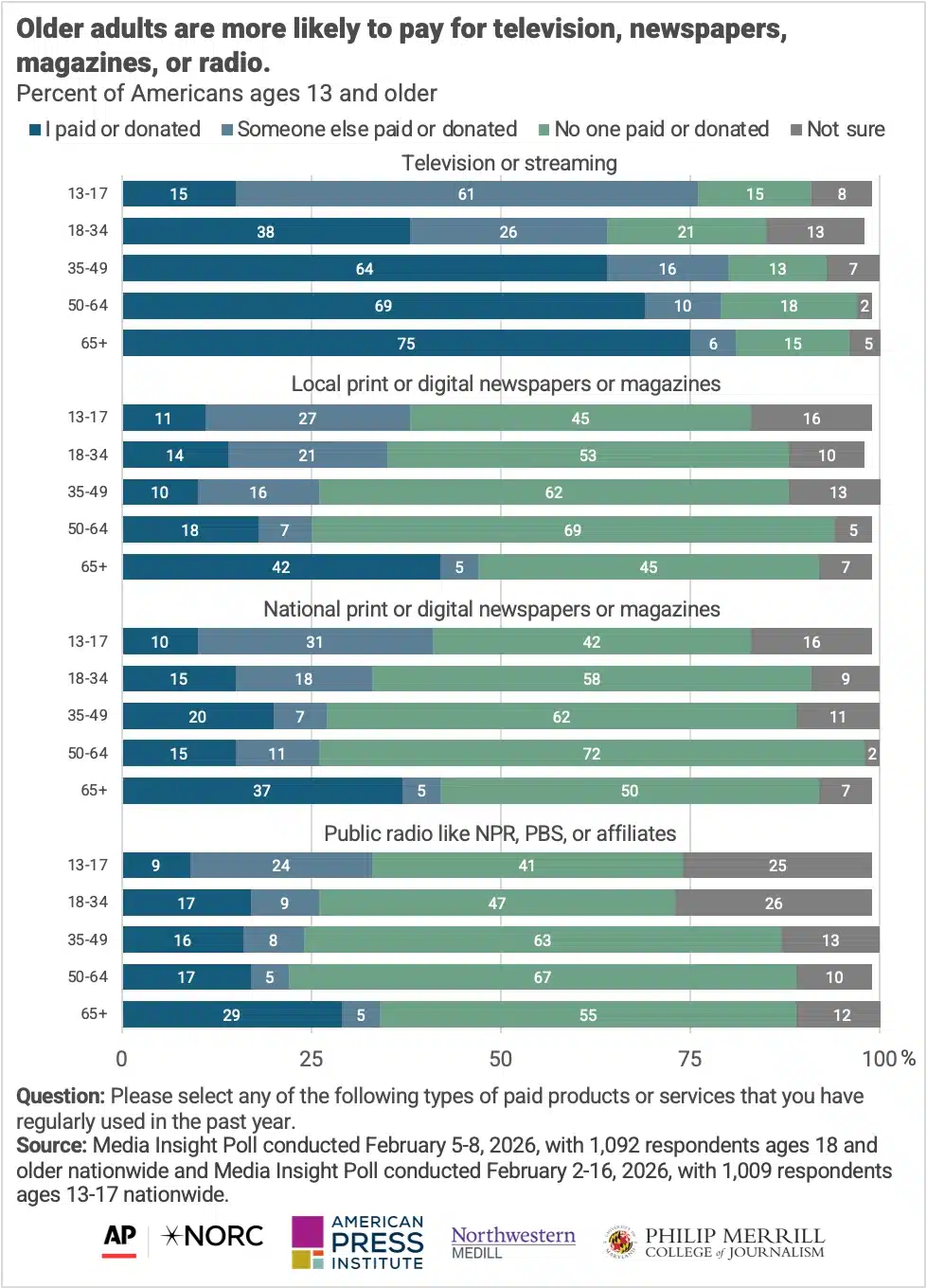
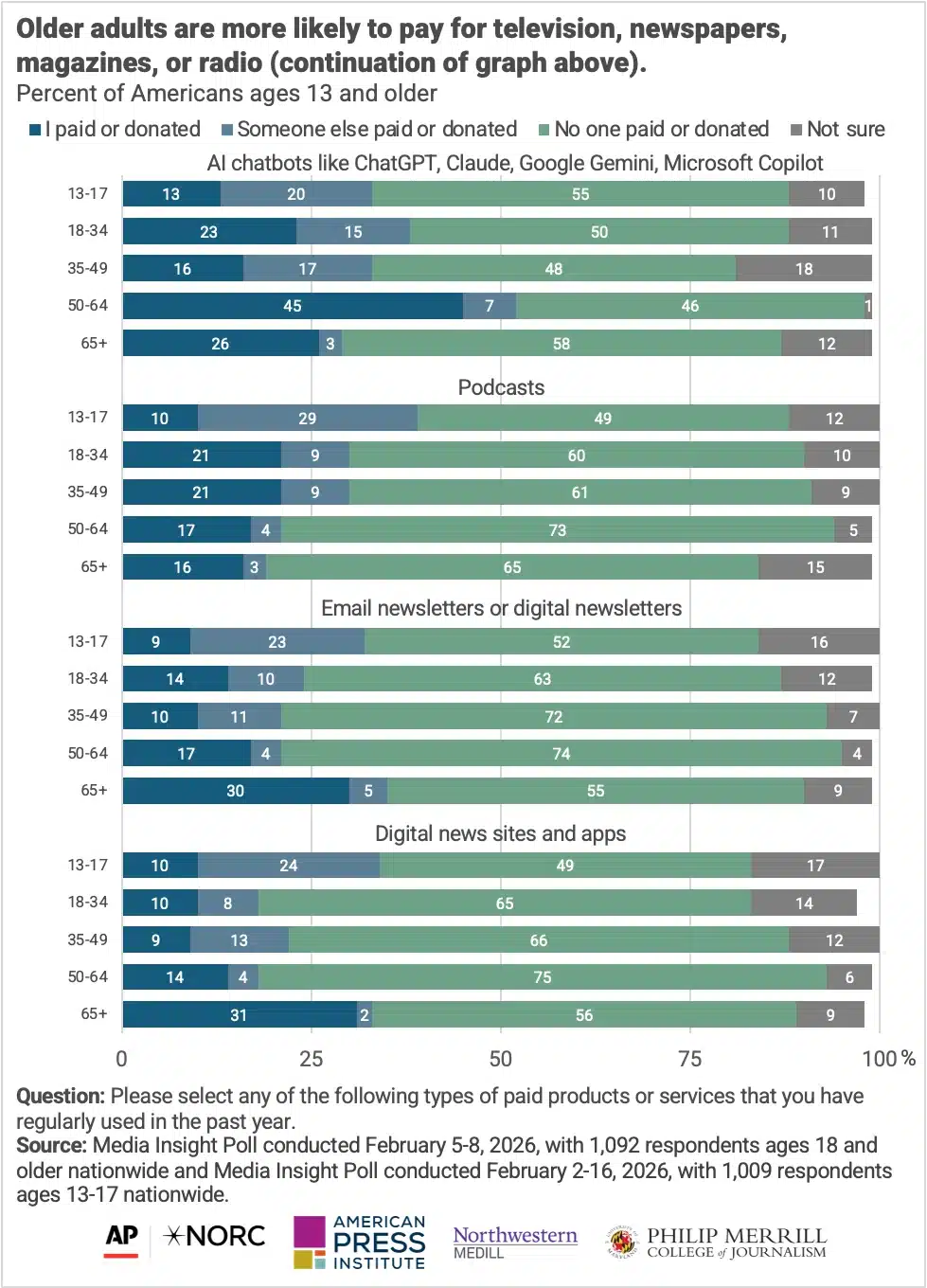
Many teens and adults pay or donate to a range of media and information services they use regularly — including both news sources and other types of media, ranging from traditional outlets to television and streaming services.
Overall, about 7 in 10 Americans say they themselves pay or donate or someone else pays or donates to at least one of the products or services they use regularly to get news, information, or other media content. Fifty-seven percent personally pay for or donate to these products or services, and 23% use services paid for by someone else. Twelve percent both pay for their own services and share a subscription with someone else.
When it comes to using any paid products at all, regardless of who pays, 18- to 34-year-olds (54%) are the least likely to be using these services. About 7 in 10 teens and adults ages 35-64 use at least one paid product. Eighty-one percent of those 65 and older use a paid product.
Fifty-eight percent of teens and adults personally pay for or donate to television or streaming services while about a quarter personally pay for or donate to AI chatbots. National or local print or digital newspapers or magazines, as well as public radio, podcasts, or newsletters are the next most commonly paid service, with about 2 in 10 personally paying for or donating to these products.
Two in 10 are using someone else’s paid streaming services. Only about 1 in 10 Americans are sharing subscriptions for products like local newspapers, national newspapers, public radio, digital news sites, podcasts, newsletters, or AI services.
What products people pay for or donate to vary depending on how closely someone follows hard news topics regularly. Those who are categorized as avid hard news consumers are more likely than moderate or low hard news consumers to personally pay for or donate to local newspapers (31%), national newspapers (30%), digital news sites (27%), or digital emails or newsletters (27%).
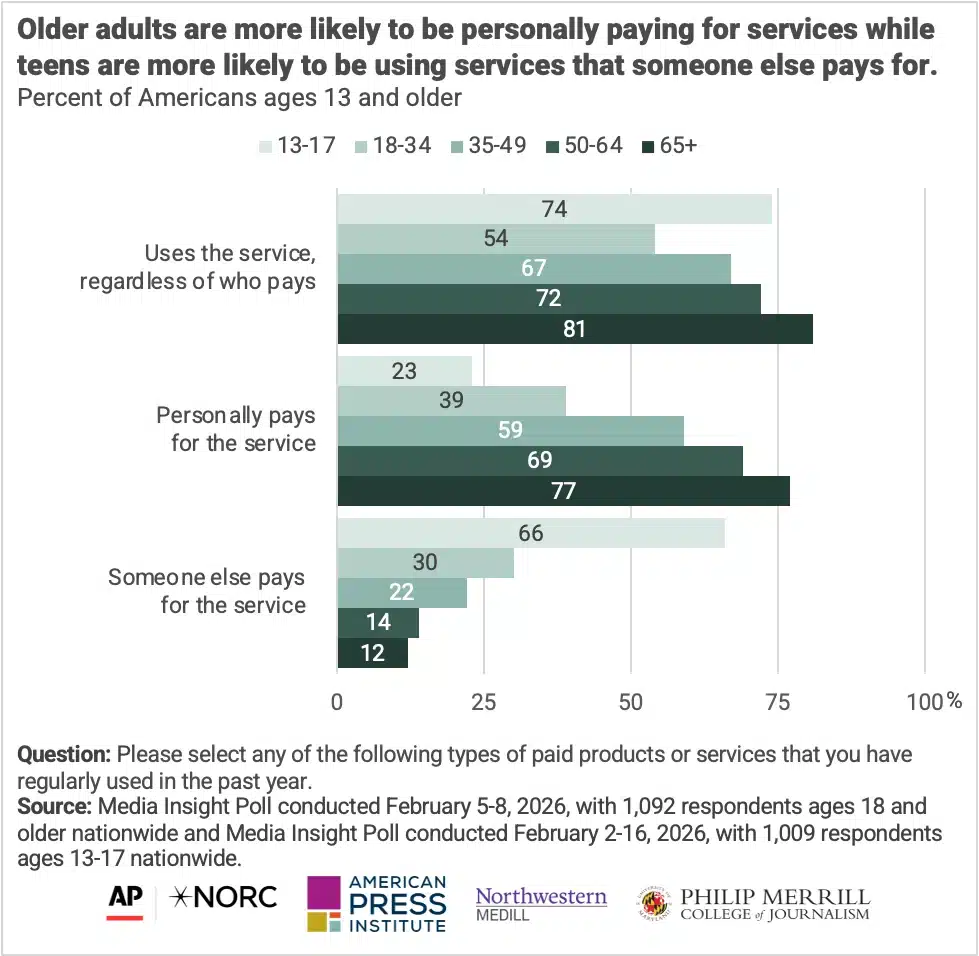
Adults are more likely to be personally paying for services while teens 13-17 are more likely to be using paid products that someone else pays for. Adults 65 or older are more likely than any other age group to be personally paying for or donating to products like local newspapers, national newspapers, or digital news sites or apps. Unsurprisingly, few teens 13-17, less than 2 in 10, are personally paying for or donating to any products or services. However, teens 13-17 are more likely than any other age group to be using streaming services or listening to podcasts that someone else is paying for or donating to.