

To be successful and create value as a news industry, we have to meet our audiences where they are and build relationships over time. Every news organization, from legacy to startup, is trying to figure out what combination of things helps foster the long-term relationships that get people to pay for quality journalism. We know that individuals and households have a list of subscriptions, from Netflix to Hello Fresh. How do we take advantage of this trend to move some of that money to their trusted news sources?
New research by the Media Insight Project finds that about 7 in 10 Americans surveyed regularly use a paid news product or service to get news, information or other media content.
News organizations across the country are competing to get consumers to choose and trust them. To understand what’s working and what challenges newsrooms continue to face, API spoke to people from The Boston Globe, The Texas Tribune, the Minnesota Star Tribune and The Seattle Times about their strategies around subscriptions and membership.
More on changing media habits
- The evolving news landscape: Comparing media habits and trust between teens and adults
- What teens are saying about the content they trust — and how local news can engage them
- 4 takeaways for local news leaders from a study on news consumption by U.S. teens and adults
- How local newsrooms can adapt to changing news habits
Expand revenue through group access
During the golden age of newspapers, families shared the printed product. Each person had their favorite section. In some families, there were rules about who got to read first, how to fold the paper properly, what got saved or thrown away. In our digital age, sharing is different. To share stories, people provide links and hope that the story isn’t paywalled, or that the news organization allows gifting. But for families to have that golden age experience, sharing digital subscriptions is the only way.
The MIP research found that 23% of people surveyed use services paid for by someone else, and 12% both pay for their own services and share their subscription. Knowing that sharing — especially with family members — is a well-worn behavior, some organizations are trying to formalize it.
Earlier this year, The Boston Globe experimented with allowing subscribers to “gift” articles — sharing them for free with their friends — and saw some immediate success. Jim Bodor, vice president of product at The Globe, talked about the impact via email. “Leveraging a mix of owned channels (print and digital) targeting subscribers, the campaign drove an +18% increase in tool usage compared to the month prior to launch (May vs. April).”
Bodor also talked about overall trends The Globe is seeing in subscription sharing. Internal data showed account sharing was happening between parents and their kids as well as extended relatives. In response, The Globe is developing a bonus subscription program where subscribers can add family members to the account with no added cost.
“Even if we don’t add a fee for that service now, this provides a source of potential future subscribers, while also reducing the unapproved account sharing we currently see,” Bodor said. “Later, we may allow subscribers to add more users for an additional fee, opening up a new revenue stream. We know others such as The New York Times and Netflix have seen great growth through this tactic.”
Bundling for the avid consumers
Another way news organizations can increase the value of a subscription or membership is by sweetening the pot with other addons. A number of news organizations are experimenting with events, big and small. Bundling membership and having member-only events is something The Texas Tribune has been doing for some time.
They are finding success with offering member discounts to their Texas Tribune Festival, a multi-day ideas summit: When members give $100 or more annually, they get discounted tickets.
“It is one of the main ways where we do see people intentionally increasing their giving,” said Emily Iazzetti, director of membership at The Texas Tribune. “They get a registration discount, they get priority access to our keynote sessions. There’s some member-only events at the festival. And so we do see that people who are interested in coming to that festival are more willing to make that $100 donation.”

Photo by Lorianne Willett for The Texas Tribune
For avid consumers of news, providing experiences that allow them to go deeper into current issues can lead to retention, creating a stickiness to what an organization provides.
However, Iazetti cautions that news organizations also have to find a balance between creating something special for their existing members and not alienating potential members.
“We have really reevaluated what events we are doing that are member exclusive. So having events that are free and open to everyone is a really important part of the value and the mission of The Texas Tribune,” Iazzetti said. They’ve worked to facilitate events that are special enough that members find them valuable but don’t take away from the mission of supporting the state’s civic education.
Conversion through content
Some news organizations attract and retain members or subscribers by appealing to their special interests. The MIP report identified a few topics that had some stickiness, offering insight into areas where media outlets can build loyalty.
For example, teenagers and young adults tend to follow fewer topics regularly than older adults. However, when it comes to news about sports, teens and adults ages 65 and older follow the topic at a similar rate (37% vs. 42%), according to the MIP report.
The Minnesota Star Tribune has been testing that theory for at least two years with high school sports. Minnesota is a self-proclaimed State of Hockey, so there are certain rivalries that everyone follows. When those games and livestreams were put behind a paywall, the conversion rates for those stories were off the charts, product manager Sydney Lewis said. For one particular game, the Star Tribune saw a 5% conversion rate, which was three times more than previous livestreams.
Once the Star Tribune understood it had an audience willing to pay for high school sports content, it decided to build a product around it called Strib Varsity. Lewis said they took the concept of “seeing your kid’s name in the paper” to a digitally scalable version designed for fans of high school sports.
“[It’s] not really a totally different audience for us, but it’s going really deep on something that we know that audience cares about,” Lewis said. “I also think it’s one of the best examples of prioritizing your users and their needs, and not just following what other news organizations do.”
Compared to the news vertical section of the Star Tribune’s digital experience, Strib Varsity’s structure creates a stickiness to engagement and recurring visits. Having school and team pages that fans can follow over a season deepens the relationship. Typically, Lewis says news articles have a strong showing in the first 24 hours but engagement can wane afterwards, whereas Strib Varsity pages tend to have more staying power because content grows over time.
“What your team’s page looks like at the start of the season is going to be inherently different from what it looks like at the end as we have more stats, we have more livestreams you’ve been a part of, we have more articles that you’ve been mentioned in,” Lewis said.
“It’s an inherent habit-building tool because you want to see how your team is doing over the course of a season. Once we launch athlete pages this fall, it’ll be the same thing — you want to see how your kid is performing over the course of a season.”
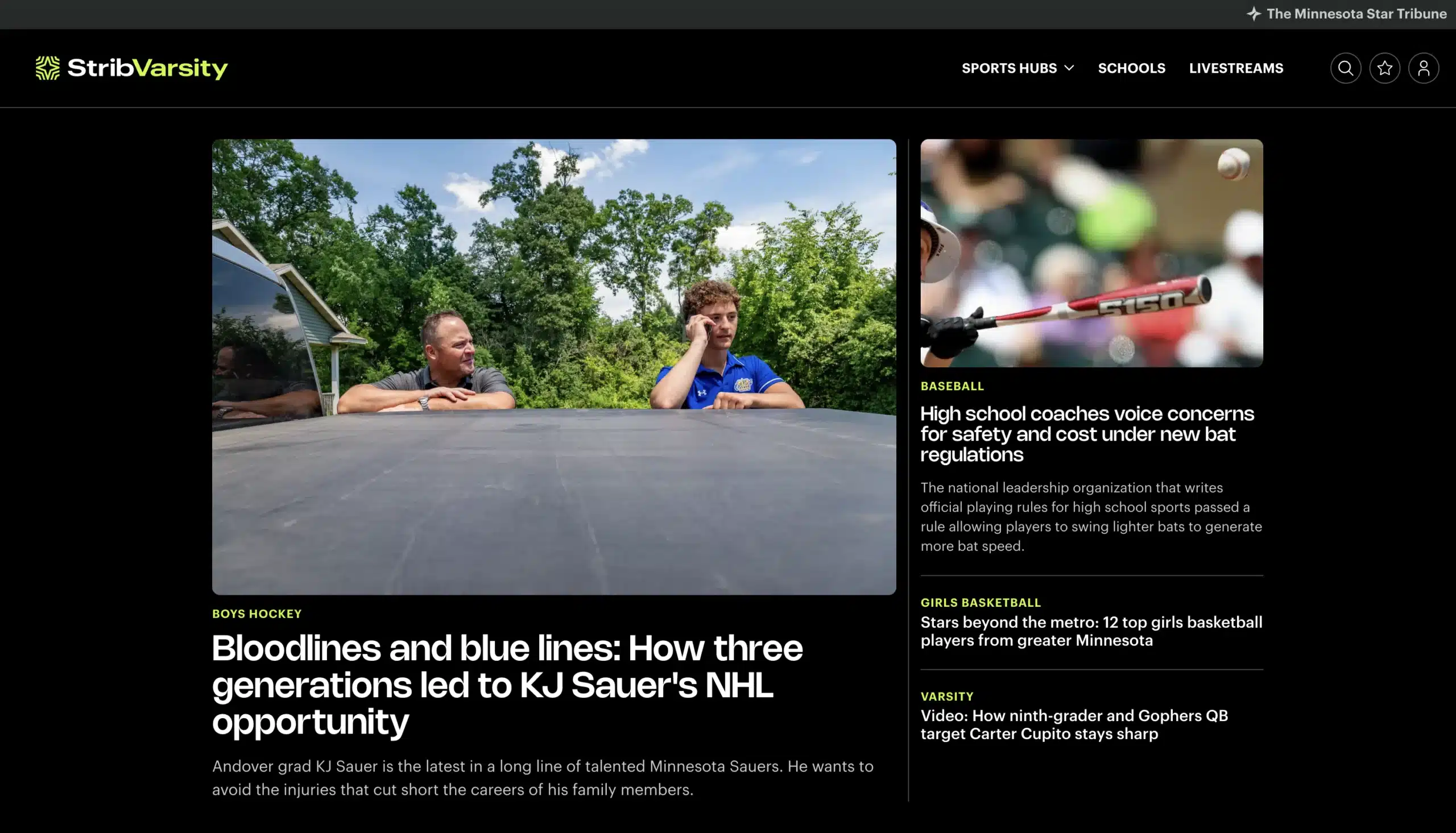
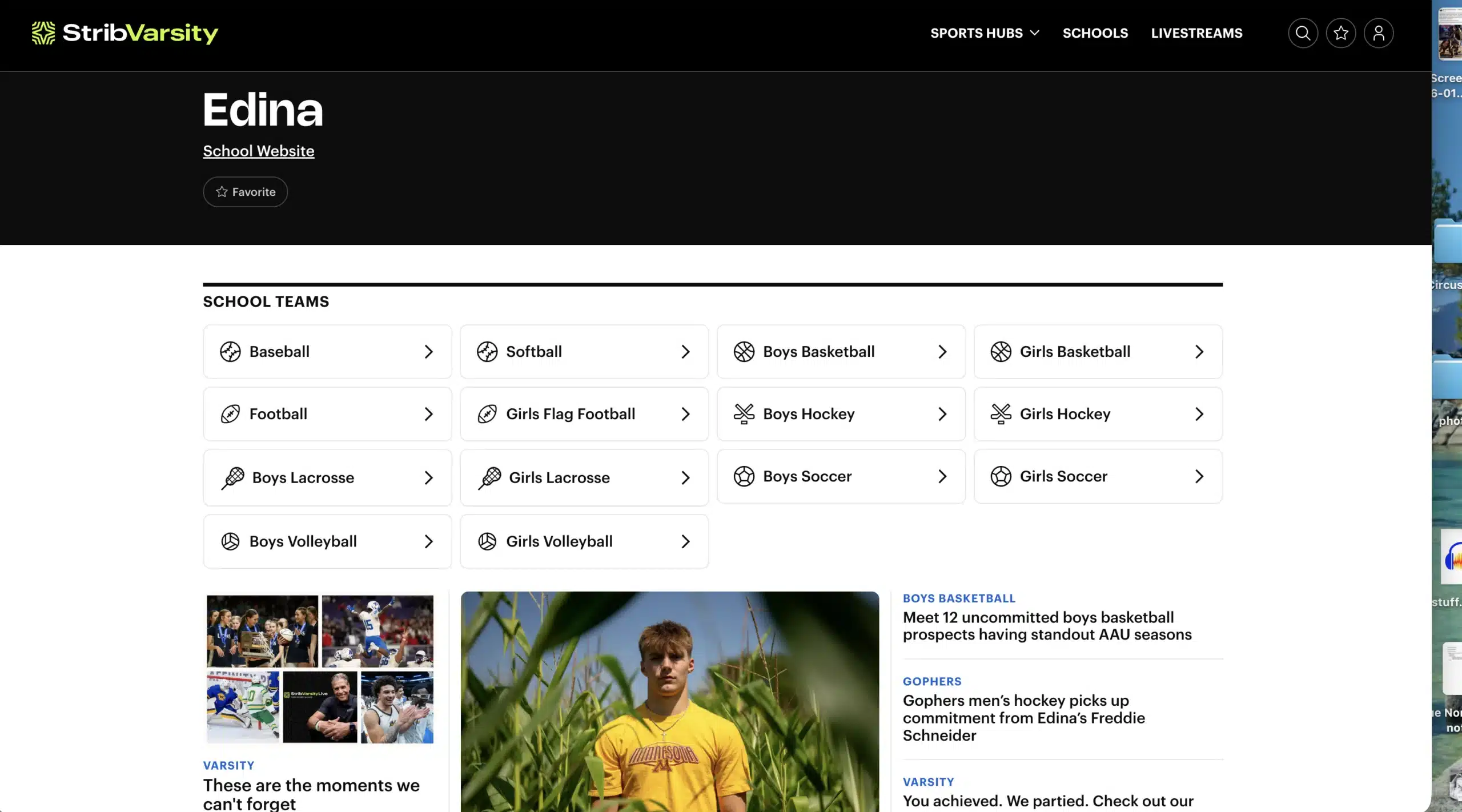
Screenshots of Strib landing pages
With this level of engagement, they’ve seen their audience not only become invested in the content Strib Varsity is providing but in the success of the tool itself.
“The number of emails that we get, the amount of feedback we get whenever we try to do a user study…people are so excited to help us improve this, help us figure out what’s next,” Lewis said. “Our people are really grateful that we’re investing in high school sports, which has been really great to hear and see and talk to people about.”
Because of how this franchise can package lists, articles and recurring columns, the Star Tribune is also able to capitalize on sponsorship. They are attracting categories of brands that they have not had relationships with in the past, such as grocery, quick-service restaurants and higher education.
The universal theme from all people interviewed was that the foundation of sustainable relationships with audiences is quality journalism.
Curtis Huber, senior director of circulation and revenue at The Seattle Times, said that they are trying to keep things simple.
“Let’s stay focused on the fact that our content is our value proposition,” he told API. “It’s not a bunch of other games. It’s not a bunch of other tricks. And yes, there’s things we want to do to price anchor and build things to drive value. But it’s about our content. And we’re going to stay laser-focused on that.”
Covering your community with fairness, care and consistency is ultimately what will drive membership and create that sticky engagement.
Kyndell Harkness is an award-winning newsroom executive and culture strategist with over two decades of experience driving institutional change. Most of her career was spent at the Minnesota Star Tribune before starting her own consulting business, Infinite Voices. Harkness still calls Minneapolis home with her wife and teenage son.
Advice for newsroom leaders
 Sydney Lewis, product manager for the Minnesota Star Tribune
Experiment and iterate: Don’t be afraid to try new things. Test, learn and repeat. If the project isn’t working don’t be afraid to pull the plug.

Thomas Brown, chief consumer revenue officer for The Boston Globe
A/B testing: There needs to be a control group to give the results you’re seeing shape and clarity. This can build confidence in the process and “reduce emotional aspects of decision-making”.
Direct relationships: Building direct relationships can create “stability in an industry that is being constantly disrupted.” Direct subscriber relationships make your organization less vulnerable to changes from the major platforms hoping they refer consumers back to your journalism.
 Curtis Huber, senior director of circulation and revenue at The Seattle Times

Separating your churn: With new subscribers (less than a year) there’s an expectation of losing more of those customers than core subscribers (more than a year). For the new subscribers, focus on relationship building. With long time subscribers, really investigate the why behind their leaving.
You might also be interested in:
There are three tactical ways local newsrooms can be the conveners for their communities: designing for human connection, designing for everyday usefulness and designing for joy, curiosity and surprise.
How do we bridge that gap between the standard KPIs and those mushier signals of your work’s impact — how can you identify and quantify what’s changing in the lives and perceptions of the communities you serve?
We asked four summit participants to share more about the ways they are defining, measuring and acting on signals of impact.


